
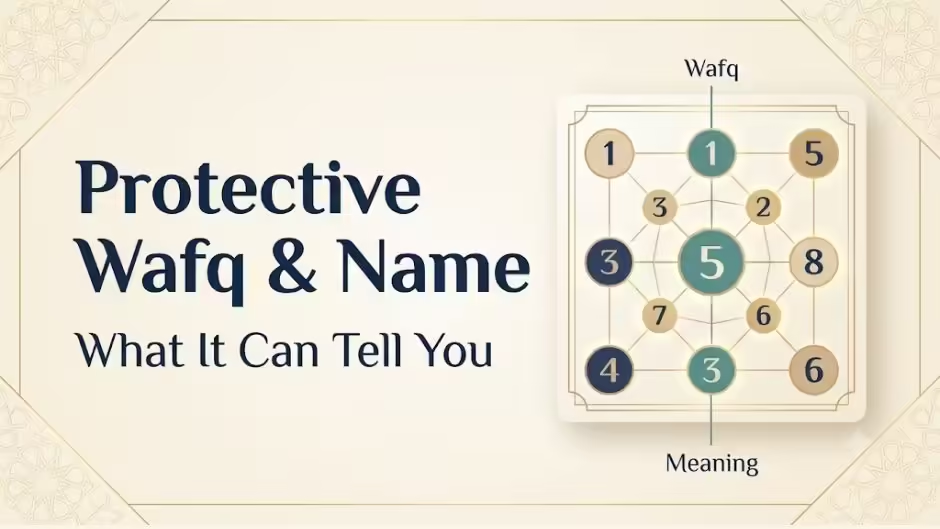
You've probably heard someone say that a name "carries weight" or that certain names seem to bring calm and goodness wherever they go. In Islamic scholarly tradition, that idea has a precise mathematical expression: the letters of a name each hold a numerical value, and when those values are arranged into a structured grid called a Wafq, the pattern itself is thought to carry a kind of ordered, harmonious energy. Whether you approach this as history, linguistics or personal reflection, the process is genuinely fascinating.
A Wafq (also written Wafk or Wafaq) is a magic square built from the Abjad numerical values of Arabic letters in a name or phrase. Each row, column and diagonal in the completed grid sums to the same total, a property mathematicians call a "magic constant." Traditionally, scholars of Islamic esotericism generated these squares as talismanic objects, believing the mathematical harmony of the grid reflected or amplified a name's inherent qualities. Calculating one for your own name gives you a window into how those scholars thought about letters, numbers and meaning.
Where This Tradition Actually Comes From
The Abjad system assigns a fixed numerical value to each letter of the Arabic alphabet, following an ordering inherited from older Semitic scripts, not the standard alphabetical sequence used today. The word "Abjad" itself comes from the first four letters in that sequence: Alif, Ba, Jim, Dal. Medieval Islamic scholars including Ibn Khaldun mentioned the use of letter-number correspondences in his 14th-century Muqaddimah, though he was careful to distinguish between its mathematical legitimacy and claims of predictive power. The magic square tradition, separately, has roots in earlier Greek and Islamic mathematical manuscripts, and was systematised by scholars of Ilm al-Huruf (the science of letters) from roughly the 9th century onward. These two streams, Abjad values and magic square geometry, were combined into the Wafq method you can explore today.
If you're new to how Abjad values work in practice, the post What Is Abjad Numerology? A Beginner's Guide to Arabic Letter Values is a good place to start before going further here.
The Practical Scenario: You Want to Understand Your Name's Numerical Character
Say your name is Ahmad, or your newborn is going to be named Maryam, or you're simply curious about the name you've carried your whole life. You want to know: what does Islamic numerological tradition actually say about the structure of this name? Not fortune-telling, not a religious verdict, just the mathematical portrait that scholars in this tradition would have drawn.
Here's the path they followed, and that you can follow too.
Step One: Get the Abjad Total Right
Before any square can be generated, you need the accurate Abjad value of the name. This is where a lot of people go wrong, because there are two main systems in use.
- Abjad Kabir (the larger system) assigns values in powers of ten up to 1,000 for Ghain. This is the classical system used in most traditional Wafq generation.
- Abjad Saghir (the smaller system) reduces all values to single digits, so letters sharing the same root digit are grouped together.
For Wafq work specifically, the classical Abjad Kabir values are almost always the correct choice, because the magic square's mathematical properties depend on the precise totals of individual letters, not compressed digits. You can calculate the Abjad Kabir value of any name quickly using the Abjad Kabir Calculator, which handles the full classical letter table and returns the grand total alongside each letter's individual value.
Step Two: Generate the Wafq Grid
Once you have the total, the grid construction begins. A 3x3 Wafq built on a total of, say, 66 (the Abjad value of Allah, widely cited in this tradition) places numbers derived from that total into nine cells so that every row, column and diagonal sums to the same magic constant. The arrangement follows specific classical algorithms that differ from basic Latin magic squares.
Doing this by hand requires knowledge of the exact construction rules, which vary by grid size and by the scholar's school of practice. The Wafq Magic Square Generator handles this automatically: you input the name or its Abjad total, choose the grid size, and the tool returns a correctly constructed square with the magic constant shown. It's the fastest way to see what a properly formed Wafq for your name actually looks like.
Worked Example: The Name Yusuf
Let's walk through a real case. The Arabic name Yusuf (يوسف) is composed of four letters: Ya (10), Waw (6), Sin (60), Fa (80). Adding those gives a total of 156 under Abjad Kabir.
A 3x3 Wafq built on 156 would have a magic constant of 156 divided by 3, which equals 52. Every row, every column and both diagonals would sum to 52. The nine cells are populated using the classical offset method (placing 1 in the middle top cell and proceeding by the standard diagonal-fill rule), then scaled to the name's letter values.
What does this tell you? Scholars in this tradition would observe that 156 reduces by digit sum to 12, then to 3, associating it with qualities traditionally linked to the number 3 in Islamic numerical symbolism: completion, triangulation, balance. The Wafq grid itself demonstrates that the name's component values can be arranged into perfect mathematical equilibrium, which is precisely what practitioners found meaningful.
Going Deeper: Naqsh and Jafar Extensions
Some scholars extended Wafq work into Naqsh (تعویذ), a broader category of inscribed talismanic designs that could incorporate Quranic text, Asma ul-Husna values and geometric elements alongside the magic square. If you want to see how a name translates into a Naqsh pattern, the Naqsh Generator on this site produces these designs from a name's Abjad input.
For those interested in the broader predictive layer that classical Jafar scholars applied, the Ilm-ul-Jafar Calculator works from similar Abjad foundations but applies the interpretive framework of Ilm al-Jafar, a separate (and historically more contested) branch of the letter-science tradition.
This site offers 25 Islamic and Abjad calculators as part of its wider collection of 200+ tools across 12 numerological and astrological traditions, so there's a natural path deeper into whichever layer of this subject interests you most.
One Mistake to Avoid
The single most common error people make when generating a Wafq is using a transliterated English spelling rather than the correct Arabic letter sequence. The name "Omar" spelled in English might be rendered with five Latin characters, but in Arabic it is typically three root letters (Ain, Mim, Ra), each carrying a specific Abjad value. A Wafq built on the wrong letter count produces a grid with incorrect proportions, and the magic constant won't reflect the name as it's actually structured in the tradition. Always work from the Arabic form of the name, and if you're unsure of the correct spelling, the Abjad Kabir Calculator accepts Arabic-script input and will parse each letter individually for you.
Things People Wonder About Wafq and Name Numerology
What is a Wafq magic square and how is it different from a regular magic square?
A Wafq is a magic square constructed specifically from the Abjad numerical values of Arabic letters in a name or sacred phrase, so that every row, column and diagonal sums to the same total (the magic constant). A standard magic square uses arbitrary sequential numbers. The Wafq's mathematical properties are the same, but its starting values are rooted in the letter-number system of classical Arabic, giving it cultural and linguistic significance within Islamic scholarly tradition.
Does the Abjad total of a name need to be a specific number for a valid Wafq to be generated?
No. A 3x3 Wafq can technically be generated for any positive integer Abjad total, because the construction algorithm scales to the input value. Larger or smaller totals simply produce different magic constants. Classical scholars did favor certain totals for specific purposes, but there is no minimum or required value for the grid to be mathematically valid.
Is generating a Wafq for a name the same as seeking a religious ruling about it?
No. Generating a Wafq is an exercise in Islamic historical mathematics and the classical science of letters (Ilm al-Huruf). It reflects how certain medieval scholars analyzed names numerically and is best understood as a cultural and intellectual tradition. It is not a religious ruling (fatwa), a form of divination in the Islamic legal sense, or a substitute for scholarly religious guidance.
Can a non-Arabic name be used for Wafq generation?
In classical practice, Wafq generation was almost exclusively applied to Arabic-script names, because the Abjad values are assigned to Arabic letters specifically. If a non-Arabic name has an established Arabic transliteration, scholars would use that form. Some contemporary practitioners apply the method to transliterated names, but this moves away from the classical framework, and results should be understood as adaptations rather than traditional calculations.
This article is intended as an educational and cultural overview of historical Islamic numerological methods. The Wafq and Abjad traditions described here are part of a rich scholarly heritage and should not be interpreted as religious instruction, medical guidance or any form of guaranteed outcome.