
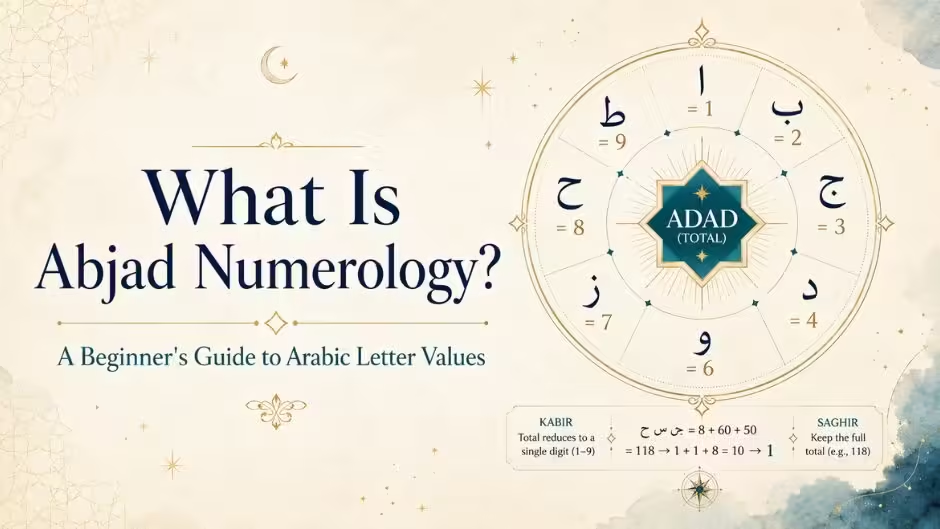
Abjad numerology is a historical Arabic system that gives every letter a fixed number, then reads the total of a name or word. It is best understood as a tradition of mathematics and linguistics from the Islamic world, where the 28 Arabic letters were used as numerals long before the modern alphabetical order became standard.
How Abjad Values Work
In the Abjad system, Alif is 1, Ba is 2, Jeem is 3, and the values continue in a fixed classical order all the way up to 1000 for Ghain. This ordering is different from the alphabetical sequence Arabic students learn today. To find the value of a name, you add the value of each of its letters. That total is called the Adad. A short name might total a few dozen, while a long phrase can run into the thousands.
You can calculate the Adad of any Arabic word with the Abjad calculator, which lists the value of each letter and the running total so you can see exactly how the number is built.
Kabir and Saghir
Two readings come up often. The Kabir, or great value, uses the full letter values described above. The Saghir, or small value, reduces that total to a single digit, in the same way Western numerology reduces numbers. Both are useful. The Kabir is used when the exact total matters, for example when comparing two names, and the Saghir is used when you want a single root number to work with.
Where It Comes From
Using letters as numbers is an old practice. The Abjad ordering was in use as a numbering system in early Islamic scholarship, and you still see it today in things like numbered lists and the lettering of older manuscripts. Similar letter-number methods appear in Greek Isopsephy and Hebrew Gematria, which suggests the idea arose more than once across the ancient world. Across these cultures, scholars noticed that words could be compared by their totals, and that observation grew into the lettered arithmetic now grouped under Islamic numerology.
What People Use It For
Within the tradition, the Adad of a name is used to compare two names, to study Quranic words numerically, to choose a name with a particular value, and to look for a divine name that shares the same root number. You can explore the full set of these tools on the Islamic numerology page, which covers everything from lucky-number analysis to the science of letters known as Ilm-ul-Huroof. These uses are cultural and historical, not religious rulings, and results are best treated as study and reflection.
Frequently Asked Questions
Is Abjad the same as the modern Arabic alphabet order?
No. Abjad follows an older fixed order where each letter has a set numerical value, starting Alif 1, Ba 2, Jeem 3. The modern alphabetical order that is taught today arranges the letters differently and is not used for these calculations.
Do I need to write the name in Arabic script?
Yes. For an accurate Adad you enter the name in Arabic letters, because the values belong to specific Arabic characters. Latin transliteration has no classical Abjad value of its own.
What is the difference between Kabir and Saghir values?
The Kabir is the full total of the letter values. The Saghir reduces that total to a single digit. You use the Kabir when the exact number matters and the Saghir when you want one root number to work with.
Is Abjad numerology a religious practice?
It is best described as a historical and cultural tradition of letter-based mathematics, not a religious ruling. People study it for cultural and linguistic interest, and results should not be treated as religious guidance.