
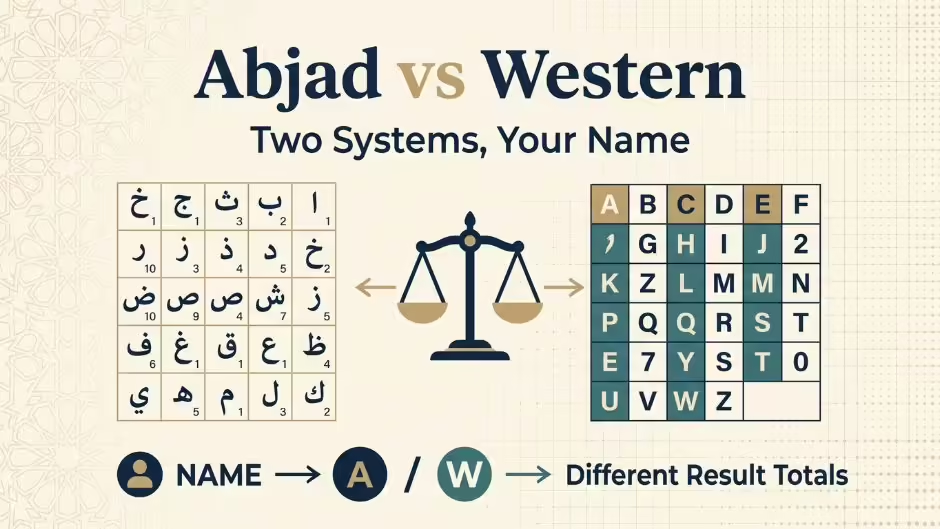
You type your name into two different numerology tools and get two completely different numbers. One system says your name carries the energy of a 7, rooted in introspection and knowledge. The other gives you a 3, associated with creativity and expression. Both are calculating the same letters. So which one is right, and what is actually going on?
When the same name is run through Abjad numerology and Western (Pythagorean) numerology, the resulting totals almost always differ, sometimes by a large margin. That gap exists because the two systems use entirely different letter-to-number maps, built on different alphabets, different historical traditions and different cultural purposes. Understanding the gap is often more revealing than either number on its own.
Two Alphabets, Two Philosophies
Western Pythagorean numerology assigns values 1 through 9 to the 26 letters of the Latin alphabet in a simple sequential cycle: A=1, B=2, C=3, and so on, wrapping back to 1 after each group of nine. The total is then reduced to a single digit (or a master number) through a process of repeated addition. The focus is on the personality and expression the name projects in this lifetime.
Abjad numerology, by contrast, draws on a much older positional system rooted in the Semitic alphabet. Each Arabic (and Hebrew) letter carries a value drawn from an ancient ordering called the Abjad sequence: the first nine letters equal 1 through 9, the next nine equal 10 through 90 (in tens), and the final letters equal 100 through 1000. A name like Yusuf, for instance, accumulates a total in the hundreds before any reduction. The Kabir (unreduced) total and the Saghir (digitally reduced) total both carry meaning in the Abjad tradition.
Because the underlying alphabets are different, comparing a Latin-script name across both systems requires careful transliteration. A letter like "S" in English maps to Seen (س) in Arabic, but the phonetic match is approximate and practitioners sometimes disagree on the correct Arabic equivalent of a foreign consonant. That disagreement alone can shift the Abjad total by dozens of points.
Historical Context
The Abjad letter-value system is documented in Arabic grammatical and philosophical texts from at least the 8th century CE, with clear antecedents in the Hebrew Gematria tradition. Scholars such as al-Ghazali referenced letter-number correspondence in discussions of divine names. The Western Pythagorean grid, attributed in spirit to the Greek mathematician Pythagoras (c. 570 to 495 BCE), was systematised into its modern form largely in the 19th and 20th centuries by Western occultists and numerologists including L. Dow Balliett and later Florence Campbell. The two traditions evolved in parallel, not in dialogue.
A Worked Comparison: The Name "Layla"
Take the name Layla as a practical test case.
Western Pythagorean calculation: L=3, A=1, Y=7, L=3, A=1. Total: 15. Reduced: 1+5=6. Expression number: 6, traditionally associated with nurturing, responsibility and harmony.
Abjad Kabir calculation: Written in Arabic as ليلى. Lam (ل)=30, Ya (ي)=10, Lam (ل)=30, Alif Maqsura (ى)=10. Total: 80. Saghir reduction: 8+0=8, traditionally associated with material mastery, ambition and, in some readings, challenge.
The same name, one person: a 6 in one tradition, an 8 in another. Neither is "wrong." They are measuring different things through different cultural lenses, a point worth keeping in mind if you have ever wondered how the same number can carry opposite meanings across systems.
To run this comparison yourself without arithmetic errors, the Cross-System Letter Value Comparator lets you enter a name and see its assigned value under multiple letter-numbering traditions side by side. That is particularly useful when you are not sure how a name transliterates, because you can test several spellings and see how much the total shifts.
Where the Reduction Path Matters
One often-overlooked difference is how each tradition handles the journey to a single digit. In Western numerology, you reduce step by step: 15 becomes 6. In Abjad, the Kabir total (80) is considered meaningful in its own right before any reduction. An 80 is not just "an 8"; it sits in the tens column of the Abjad scale and some practitioners read it specifically as Lam-family energy.
If you want to trace the reduction steps explicitly, the Digital Root Steps Calculator shows each stage of the addition process so you can see exactly how a large Abjad total collapses down to its root digit. That transparency helps you verify manual calculations and understand where a final number actually comes from.
Which System Should You Use?
The honest answer is: it depends on the cultural and linguistic frame that is most meaningful to you. If your name is Arabic or Persian in origin and you are working within an Arabic-speaking or Islamic cultural context, Abjad is the more historically appropriate tool. If you are working with a Latin-alphabet name and Western numerological tradition, the Pythagorean grid makes more sense. Many people find value in reading both and treating them as complementary lenses rather than competing answers.
Where it gets genuinely interesting is when you have a bilingual name or a name used across two cultures. In that case, running both calculations and noticing where they converge or diverge can tell you something about the different energies a name carries in each community. Our site currently offers more than 200 free calculators across 12 numerology and divination traditions, including 25 Islamic and Abjad tools and 26 Western numerology tools, so you can explore both sides without switching platforms.
A Practical Checklist Before You Compare
- Decide whether you are using the name as spelled in the original language or as transliterated into another alphabet.
- For Abjad: confirm whether you are using Kabir (full values) or Saghir (reduced). Do not mix them mid-calculation.
- For Western: confirm whether you are using Pythagorean (sequential 1 to 9) or Chaldean (1 to 8, with different letter assignments). These produce different results even within the Western tradition.
- Note the unreduced total as well as the final root digit. Both carry information.
- If comparing a name across systems, use the same phonetic spelling consistently.
What People Wonder When Comparing These Systems
Why does my name give a completely different number in Abjad versus Western numerology?
The two systems use entirely different letter-to-number maps. Western Pythagorean numerology assigns values 1 through 9 sequentially to the Latin alphabet. Abjad numerology assigns values derived from an ancient Semitic letter-ordering where letters represent units, tens and hundreds. Because the underlying alphabets and value scales are different, the same name almost always produces a different total in each system. Neither result is incorrect; they simply reflect different cultural frameworks measuring different things.
Do I need to write my name in Arabic script to use Abjad numerology?
For a genuine Abjad calculation, yes, the name should be rendered in Arabic script because the values are assigned to Arabic letters, not to Latin transliterations. When you transliterate an English name into Arabic phonetically, some letter-matching choices (especially for sounds that do not exist in Arabic) are debatable, and different practitioners may produce slightly different totals. The Cross-System Letter Value Comparator on this site can help you test several transliteration options to see how much the result shifts.
Is it valid to read both systems for the same name?
Many practitioners do read both, treating them as separate lenses rather than competing authorities. The Western result tends to reflect how the name functions in a Latin-alphabet cultural context, while the Abjad result connects the name to its Arabic linguistic and historical heritage. If your name is used in both contexts, both readings can offer something useful. What is not recommended is blending the two arithmetic systems into a single hybrid calculation, since the resulting number would not correspond to either tradition.
What is the difference between Abjad Kabir and Abjad Saghir?
Kabir (meaning "large" or "full") refers to the unreduced Abjad total, where letters retain their full positional values (units, tens, hundreds). Saghir (meaning "small" or "reduced") is the single-digit root obtained by summing the digits of the Kabir total until only one digit remains. Both totals are considered meaningful in traditional Abjad practice. Many practitioners look at the Kabir total first for the complete picture, then reduce to Saghir for the core energy or root quality.
This article is intended for educational, cultural and historical exploration of numerological traditions. It does not constitute religious guidance, personal advice or a predictive claim about any individual's name or destiny.