
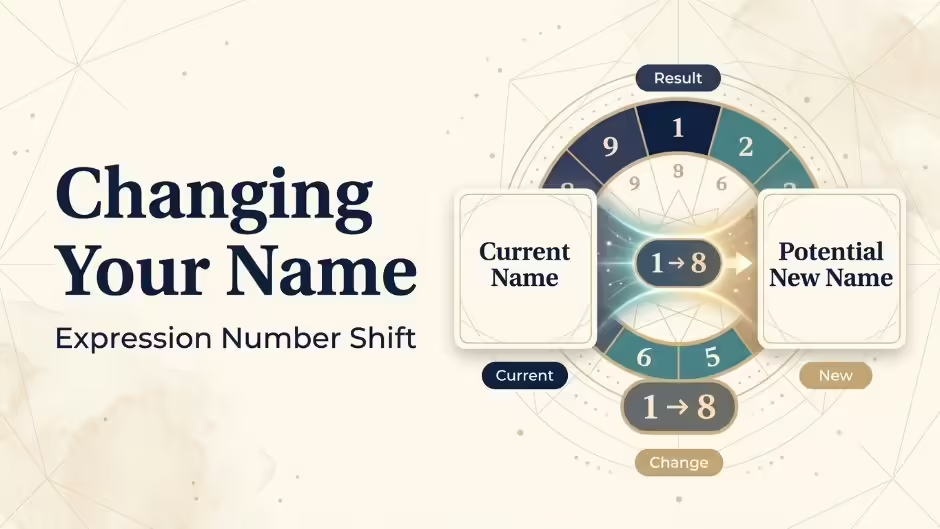
Changing your name is one of the most personal decisions you'll ever make. Whether you're stepping away from a marriage, returning to a birth name, or simply shedding a name that never felt like yours, the choice carries real emotional weight. Most people spend weeks weighing the social and legal practicalities. Very few spend any time thinking about the numerical character the new name carries with it.
Western numerology treats every name as a numerical signature. Each letter maps to a digit, those digits reduce to a single core number (with specific exceptions), and that number is traditionally associated with a set of qualities, drives and life themes. Change the name and you change the signature. The question worth asking before you file any paperwork is: what exactly are you changing it to?
Why People Come to This Question in the First Place
Here is a situation that comes up more often than you might expect. You have been through a divorce and you are ready to drop your married surname, return to your birth name, or take something entirely new. You feel lighter just thinking about it. Then a friend who knows a little numerology mentions, almost offhandedly, that your current name and your intended name carry very different numerical characters. Now you are curious, and maybe a little unsettled.
Or the reverse happens. You are about to take a partner's surname after a wedding, and someone points out that the change could shift your Expression Number from a 1 (traditionally associated with independence and self-direction) to a 6 (traditionally linked to nurturing, responsibility and home life). That is not necessarily a problem. But knowing it in advance gives you something real to sit with before you commit.
These are specific, practical situations, and numerology has a concrete, calculable answer for them. That is exactly what this page walks you through.
The Tradition Behind the Letter-to-Number System
The system used in Western numerology today is most closely tied to the Pythagorean tradition, named for the Greek mathematician Pythagoras (approximately 570 to 495 BCE), who taught that number is the underlying principle of all things. The specific mapping of the Latin alphabet to the digits 1 through 9 was formalised later by Western occultists and numerologists during the 19th and early 20th centuries. Writers like L. Dow Balliett helped popularise it in print. The method assigns letters sequentially: A=1, B=2, C=3, and so on, cycling back to 1 after 9, right through to Z=8.
It is worth being clear about what this system is. It is a tradition with a long history in Western esoteric thought, not a scientifically validated framework. The associations attached to each number are cultural and symbolic, built up over centuries of use. Think of it as a structured reflective tool rather than a predictive one.
The One Number That Actually Changes With Your Name
Of all the core numbers in a Western numerology chart, the Expression Number (sometimes called the Destiny Number) is the one most directly affected by a name change, because it is calculated entirely from your full name. It is completely separate from your Life Path Number, which comes from your date of birth and stays fixed regardless of what you call yourself.
The Expression Number is traditionally understood to describe your natural abilities, the direction your energy tends to move in, and the way you show up in the world. When you change your name, you change this number, and with it the numerological description of your strengths and tendencies. Understanding that shift before you commit is exactly the kind of reflection this page is designed to support.
How to Calculate Your Expression Number Shift, Step by Step
You do not need special tools to compare your current name against a potential new one. Run through these steps for each name in turn.
- Write out the full legal name. Use the complete name as it would appear on official documents, including middle names if they are part of the legal record.
- Assign each letter its Pythagorean value. Use this reference chart: A=1, B=2, C=3, D=4, E=5, F=6, G=7, H=8, I=9, J=1, K=2, L=3, M=4, N=5, O=6, P=7, Q=8, R=9, S=1, T=2, U=3, V=4, W=5, X=6, Y=7, Z=8.
- Add all the digits together. Then reduce the total to a single digit by adding the digits of the result together. Keep reducing until you reach a single digit, unless you land on 11, 22 or 33. Those are preserved as master numbers in most Western systems.
- Repeat for the new name. Then compare the two results side by side.
If you would rather skip the arithmetic, the Expression (Destiny) Number Calculator handles the full calculation for you. Run it once for your current name and once for the name you are considering. The contrast between the two results is where the real insight lives.
A Worked Example: Comparing Two Names Side by Side
Say Maya Thompson (her married name) is thinking about returning to Maya Adler (her birth name) after a separation. Using the Pythagorean system, the calculation looks like this.
For Maya Thompson: M=4, A=1, Y=7, A=1, T=2, H=8, O=6, M=4, P=7, S=1, O=6, N=5. Adding those gives 52, and 5+2=7.
For Maya Adler: M=4, A=1, Y=7, A=1, A=1, D=4, L=3, E=5, R=9. Adding those gives 35, and 3+5=8.
| Name | Digits Added | Running Total | Expression Number |
|---|---|---|---|
| Maya Thompson | 4+1+7+1+2+8+6+4+7+1+6+5 | 52, then 5+2=7 | 7 |
| Maya Adler | 4+1+7+1+1+4+3+5+9 | 35, then 3+5=8 | 8 |
So Maya is moving from a 7 Expression (traditionally associated with introspection, analysis and a search for deeper meaning) to an 8 Expression (traditionally linked to ambition, material achievement and stepping into positions of authority).
Neither number is better than the other. But here is where the nuance matters. If Maya has spent her marriage quietly retreating inward and is now ready to move into a more outward, professionally assertive chapter, the 8 could feel like a natural fit for that shift. If she was hoping the name change would bring more peace and inner quiet, the 8 might give her pause. That is exactly the kind of reflection worth doing before you sign anything.
What Each Possible Expression Number Traditionally Suggests
Once you have your two numbers, you need something to compare them against. Below is a short reference for what each Expression Number is traditionally associated with in Western numerology. These are not predictions or guarantees. They are symbolic descriptions that have accumulated through centuries of use in this tradition.
- 1 - Independence, initiative, originality and a drive to lead or pioneer.
- 2 - Cooperation, sensitivity, diplomacy and a natural aptitude for partnership.
- 3 - Creative expression, communication, sociability and emotional warmth.
- 4 - Practicality, discipline, structure and a methodical approach to building things that last.
- 5 - Adaptability, curiosity, freedom and a tendency to thrive through variety and change.
- 6 - Responsibility, nurturing, a strong sense of duty and deep investment in home and family.
- 7 - Analytical thinking, introspection, a search for meaning and a preference for depth over surface.
- 8 - Ambition, material competence, authority and the capacity to manage large-scale efforts.
- 9 - Compassion, idealism, a humanitarian orientation and a pull toward service on a broad scale.
- 11 - Heightened intuition, inspiration and a pull toward spiritual or visionary work (master number, not reduced further).
- 22 - The capacity to turn ambitious vision into practical, lasting structures (master number, not reduced further).
- 33 - A rare master number traditionally associated with selfless teaching, healing and elevated creative service.
One Detail That Catches People Out
A common source of confusion is deciding which version of your name to use in the calculation. The standard practice in Western numerology is to use the full name exactly as it appears on your birth certificate or legal documents, not a nickname, a shortened version, or a name you go by socially but have never formalised.
If you are evaluating a potential new name that you intend to make legal, use the full intended legal form. If you are considering a professional name that you will use publicly but not change legally, be aware that many numerologists treat that differently from a full legal change, since the birth name is considered to carry a persistent influence in traditional Western practice.
There is no single universally agreed rule on this. Different practitioners handle it differently. The most consistent approach is to calculate both the current legal name and the intended new legal name, then compare them. That gives you the clearest picture of what is actually shifting.
Where This Fits Within a Broader Chart
The Expression Number is one piece of a larger picture. A full Western numerology chart also includes your Life Path Number (from your birthdate), your Soul Urge Number (from the vowels in your name) and your Personality Number (from the consonants), among others. A name change shifts the Expression Number and, by extension, the Soul Urge and Personality Numbers too, since all three are derived from the letters of your name.
If you want to see the full picture, our collection of Western Numerology calculators covers all 26 tools in that tradition, and the broader site offers over 200 free numerology, astrology and divination calculators across 12 traditions. Running a few of them on both your current and intended name takes only a few minutes and gives you a much more complete set of comparisons to work with.
A note on scope: this page focuses on the Pythagorean (Western) system. If you are interested in how a name change reads through the Chaldean system, which assigns different numerical values to the same letters and is considered by some practitioners to be older, that is handled separately in the Chaldean Numerology section. The two systems use different mappings and will sometimes produce different results for the same name.
A Grounded Way to Use This Information
Numerology is not a decision-making system. It does not tell you whether to change your name. What it can do is give you a concrete symbolic framework for reflecting on what you are moving toward, and what you might be leaving behind.
If the new name's Expression Number resonates with where you want to go in life, that can feel affirming. If it surprises you or feels off, that reaction itself is worth paying attention to, not because the number is a verdict, but because your response to it reveals something about your own expectations and intentions. That is where the practical value of this kind of exploration tends to live.
The associations described here reflect traditional symbolic belief developed over centuries. They are not supported by scientific research and should not be treated as predictive or prescriptive.
Your Questions, Answered
Does changing my name legally really change my numerology chart?
In Western numerology, yes, partially. Your Expression Number, Soul Urge Number and Personality Number are all derived from the letters of your name, so a legal name change alters all three. Your Life Path Number, which comes from your date of birth, remains fixed regardless of any name change.
What if my new name produces a master number like 11 or 22?
Master numbers (11, 22 and 33) are not reduced to a single digit in most Western numerology systems. They are traditionally considered to carry intensified qualities. An 11 Expression, for example, is often associated with heightened intuition and a calling toward inspirational work, but also with the pressure that comes with that sensitivity. Whether a master number feels like an asset or a challenge tends to depend very much on the individual and their circumstances.
Should I include my middle name in the calculation?
The standard practice in Western numerology is to include all names that appear on your legal documents, middle names included. If your middle name appears on your birth certificate or legal ID, it belongs in the calculation. If you are evaluating a new name you intend to formalise legally, use the full version as it will appear on official records.
Is the Pythagorean system the same as the Chaldean system?
No, they are distinct. The Pythagorean system assigns letters sequentially from 1 to 9 (A=1, B=2, C=3 and so on). The Chaldean system uses a different mapping based on a separate historical tradition and does not assign the number 9 to any letter in the same way. The two systems can produce different Expression Numbers for the same name. This page covers the Pythagorean (Western) method only.