
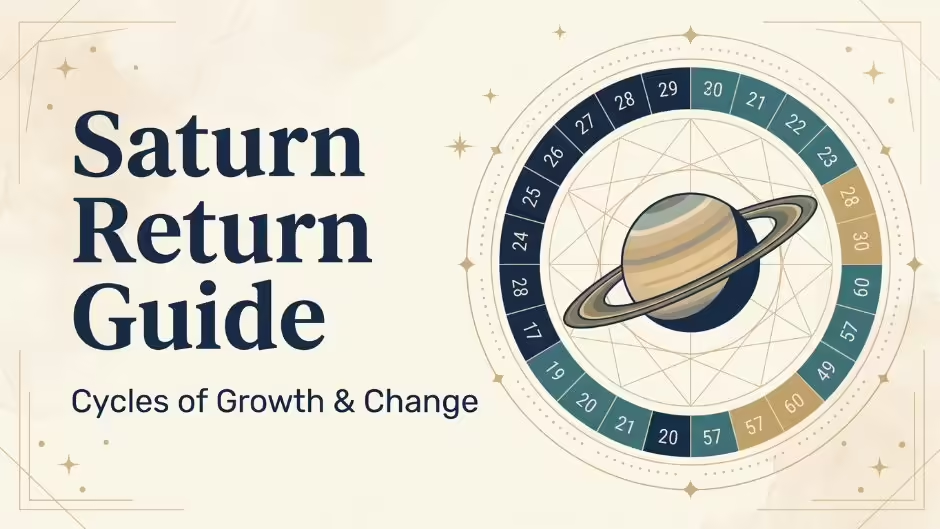
Around age 28 or 29, something shifts. A career that felt right suddenly feels hollow. A relationship reaches a breaking point. A long-postponed question about who you really are stops waiting patiently. Most people going through this assume something is wrong with them. What's actually happening is Saturn has come home.
A Saturn Return is the period when Saturn in the sky returns to the exact degree it occupied at the moment you were born. Because Saturn takes roughly 29.5 years to complete one full orbit of the sun, this return happens approximately three times in a human life: once in the late 20s, once in the late 50s and once, for the fortunate few, in the late 80s. Astrology traditionally frames each return as a reckoning, a period where structures that no longer serve you tend to fall away and where new, more authentic foundations can be laid.
Why This Period Feels So Destabilising
Saturn is associated in Western astrology with discipline, limitation, time, authority and long-term consequence. When it returns to its natal position, it is said to audit the life you have built since the last return. Anything built on shaky ground, whether that is a career chosen to please others, a relationship entered out of fear of being alone or a self-image that never quite fit, tends to come under pressure.
This is not punishment. That is the single most important thing to understand about this transit. The discomfort is structural, not personal. Saturn is not targeting you; it is testing load-bearing walls.
Vedic astrology has its own parallel concept. In Jyotish, the equivalent reckoning comes through Saturn's Sade Sati, the seven-and-a-half year period when Saturn transits through three consecutive signs, including the sign of your natal moon. The underlying idea is remarkably similar: a prolonged period of scrutiny that eventually clarifies what matters.
Calculation Nuance: The Historical Roots of Saturn's Cycle
Ancient Babylonian astronomers documented Saturn's approximate 29-year cycle as far back as the 7th century BCE. They tracked the planet's movement against fixed star positions and noted that it returned to roughly the same part of the sky across a human generation. Greek astronomers later incorporated this cycle into the philosophical framework that became Hellenistic astrology, where Saturn was associated with Kronos, the god of time, and was understood to govern the structures of material life. Medieval astrologers used Saturn's return as a marker of life's major threshold years, a concept that passed directly into Renaissance astrology and eventually into the modern Western tradition.
The First Return (Ages 27 to 30): Building on Your Own Terms
The first Saturn Return is the most commonly discussed because it tends to be the most dramatically felt. Most people arrive at this period with a life that was partially assembled by external expectations: parental hopes, social scripts about what success looks like by 30, educational paths chosen at 17 or 18.
Saturn's return asks a direct question: is this actually yours? Common themes during the first return include career changes, relationship endings or deepening commitments, relocations, health wake-up calls and a general sense of needing to take personal responsibility in ways that previously felt optional. The transit typically lasts two to three years, not a single day.
Because the exact degree and sign of your natal Saturn varies depending on your birth date, time and place, the precise window of your return is individual. You can find yours by checking your Saturn Return dates using your birth information, which will show you when transiting Saturn first hits, stations near and finally clears your natal Saturn degree.
The Second Return (Ages 57 to 60): Editing, Not Starting Over
The second Saturn Return arrives at what many cultures already recognise as a significant threshold: the approach of sixty. Where the first return is often about building, the second is more often about editing. By this point, you have spent roughly three decades constructing a life on the foundations the first return helped you establish. The second return asks whether those foundations have held, and whether the structure still reflects who you are now.
Retirement decisions, shifts in family roles (children leaving home, aging parents needing care), questions about legacy and meaning, and a genuine reassessment of how time is spent are all common second-return themes. It tends to be quieter than the first but no less significant.
If you are also curious about how wealth and material prosperity are positioned in your Vedic chart during this period, the Indu Lagna (a Jyotish calculation specifically linked to financial potential) can add a complementary layer to what the Saturn transit is surfacing.
A Real Scenario Worth Recognising
Consider someone born in late 1994. Their natal Saturn sits in Pisces. In 2023 and 2024, Saturn transited Pisces for the first time since their birth. During that window, many people in that cohort reported the same cluster of experiences: feeling like their early-to-mid 20s choices were being called to account, questioning career paths they had followed somewhat on autopilot, and facing relationship decisions they could no longer defer.
None of that is coincidence, at least not within an astrological framework. It is the transit doing exactly what tradition says it does.
What to Actually Do During a Saturn Return
Astrology does not prescribe passivity. The traditional advice for a Saturn Return is not to wait it out but to engage with it deliberately. A few practical orientations that align with what this transit is traditionally said to reward:
- Take stock honestly. Which parts of your life were chosen by you, and which were inherited or defaulted into? Saturn rewards clarity about this distinction.
- Don't make fear-based decisions. The pressure of the transit can push people into doubling down on exactly the things that need to change. Recognising this pattern helps.
- Expect slowness. Saturn governs time. Things built carefully during this period tend to last. Rushed decisions tend not to.
- Check what else is happening in your chart. Saturn does not operate in isolation. Knowing where the other planets are positioned during your return gives you a fuller picture. A planetary positions lookup for your current date and location shows you the full transit picture alongside your Saturn Return.
When Relationships Are Part of the Question
Saturn Returns frequently bring relationship decisions to a head. A partnership that has been coasting may face its first real test. Someone who has been avoiding commitment may find the avoidance becomes untenable. If you are assessing a relationship during this period, looking at astrological compatibility can be a useful grounding exercise. The zodiac compatibility tool gives you a starting point for understanding how two charts interact at the sign level, which is a reasonable first layer before going into house-by-house synastry.
And if numerology is also part of how you explore relationships, the post on Vedic numerology compatibility for couples covers the Mulank and Bhagyank pairing method in practical detail.
Things People Ask About Saturn Returns
How long does a Saturn Return actually last?
A Saturn Return is not a single day. Because Saturn moves slowly and also retrogrades, it typically takes two to three years for Saturn to pass through, station near and fully clear your natal Saturn degree. The most intense period is often when Saturn is within one or two degrees of its natal position, but the broader window of the transit spans several years.
Do I need my exact birth time to calculate my Saturn Return?
Your birth date and birth year are enough to identify which sign and approximate degree Saturn occupied when you were born, which gives you a good working window for your return. An exact birth time lets you pinpoint the natal degree more precisely and also tells you which astrological house Saturn falls in, which adds another layer of meaning about which area of life the return will affect most directly.
Is a Saturn Return always difficult, or can it be positive?
The difficulty depends largely on what you have built in the preceding years. Astrology traditionally frames the Saturn Return as a test of authenticity and structural soundness. If the life you have built aligns with your genuine values and capabilities, the return can feel more like a consolidation or promotion than a crisis. The challenging experiences tend to cluster around the areas where there is a mismatch between external structure and inner truth.
What sign is Saturn in right now, and does that affect everyone's return?
Saturn moves through each zodiac sign over roughly two and a half years. The sign it currently occupies affects the collective tone of that transit period, but your personal Saturn Return is only triggered when transiting Saturn reaches the specific degree it occupied at your birth. Two people born in the same year but with Saturn in different degrees of the same sign will experience slightly different return windows even though they share the same natal Saturn sign.
This article is written for educational and cultural interest. Astrological traditions represent historical and symbolic frameworks for self-reflection and should not replace professional advice in legal, medical, financial or relationship matters.