
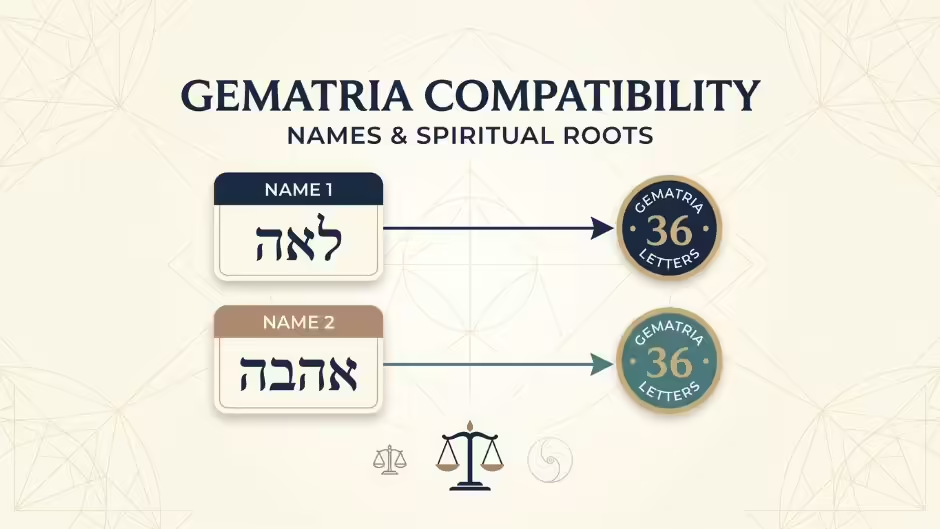
There's a specific kind of curiosity that brings people to Gematria compatibility. You're looking at two names, maybe your own and a partner's, a baby name alongside a family name, or a Hebrew word from prayer that has always felt personally significant, and you want to know whether the connection you sense is actually encoded somewhere deeper. Kabbalistic tradition has a structured, centuries-old answer to that question.
Gematria word compatibility works by calculating the numerical total of two Hebrew names, words, or phrases and comparing those sums. When the totals match, Kabbalistic thought traditionally holds that the two words share a hidden spiritual root, occupying the same position in the sacred structure of Hebrew. This isn't a modern self-help concept. Scholars, mystics, and rabbis have used this comparison method for well over a thousand years, applying it to scripture, to names, and to understanding relationships between ideas that seem unrelated on the surface.
Three Reasons People Come to This Question
Most people arrive at name compatibility through one of three very different routes, and it's worth naming them because the route shapes how you'll use the result.
Relationship reflection. A couple wants to see whether their Hebrew names carry compatible energy. This isn't meant to replace genuine connection or shared values, it's an extra layer of reflection in a tradition that treats language as spiritually charged.
Naming decisions. Whether you're naming a child, a business, or a creative project, you might want to know whether the name you've chosen harmonises numerically with an existing one, a family name, a Hebrew name already given, or a meaningful word.
Personal inquiry. Sometimes the starting point is harder to articulate: a word from Torah or liturgy has always resonated with you, and you want to know whether it's numerically linked to your own name in some concrete, verifiable way.
All three routes lead to the same practical calculation.

How the Calculation Works: The Mechanics Behind the Match
Every Hebrew letter carries a fixed numerical value. This system was codified during the mishnaic period and traces back to earlier Phoenician numbering conventions. The values run as follows: Aleph (א) equals 1, Bet (ב) equals 2, Gimel (ג) equals 3, and so on through the alphabet. The larger values belong to later letters: Kof (ק) equals 100, Resh (ר) equals 200, Shin (ש) equals 300, and Tav (ת) equals 400. To find a word's Gematria total, you simply add the values of every letter it contains.
When you compare two words or names, you're not looking for a personality match in the way a horoscope might offer one. You're looking for numerical equivalence, the traditional signal that two concepts occupy the same "place" within the architecture of Hebrew. The example most often studied in yeshivot makes this vivid: the word echad (one, אחד) and the word ahavah (love, אהבה) both equal 13. For Kabbalists, that isn't coincidence. It's evidence that unity and love are the same force expressed in two different forms.
The Gematria Word Compatibility Calculator handles this arithmetic instantly and shows you both totals side by side, which is particularly useful when you're working with transliterated names or less familiar Hebrew spellings.
What the Calculator Does and What It Needs From You
The tool takes two inputs: the first Hebrew word, name, or phrase, and the second. It then applies standard Gematria (known as Mispar Hechrachi, the simplest and most widely used system) to each input, sums the letter values, and displays both totals together so you can see immediately whether they match, and if they don't, how far apart they are.
You don't need to know the Hebrew letter values by heart. Enter the names in Hebrew characters if you can, or use the transliteration guide the tool provides. The method it uses is the straightforward additive system: each letter's value is added in sequence, left to right, with no weighting or positional adjustment.
A Worked Example: Two Names, One Honest Answer
Take a concrete scenario. A woman named Leah (לאה) wants to know whether her name has a Gematric connection to the Hebrew word for soul, neshamah (נשמה).
Leah breaks down like this: Lamed (ל) equals 30, Aleph (א) equals 1, Heh (ה) equals 5. Total: 36.
Neshamah breaks down like this: Nun (נ) equals 50, Shin (ש) equals 300, Mem (מ) equals 40, Heh (ה) equals 5. Total: 395.
Those totals don't match, so there's no direct equivalence in the standard system. But here's where the process becomes genuinely interesting rather than just a pass-or-fail result. The total of 36 is traditionally associated with the Lamed Vav Tzaddikim, the 36 hidden righteous people in Jewish mystical thought whose presence, according to legend, sustains the world. That context surfaces simply by knowing Leah's name total, and it opens a completely different line of reflection about what the name carries on its own. The comparison is the starting point, not the final word.
If you wanted to understand the symbolic weight of each individual letter before running the comparison, the Hebrew Letter Meaning Calculator breaks down the traditional associations of Lamed, Aleph, and Heh separately, adding texture to the overall reading.
Reading Your Result: What Matching Totals Actually Mean
A matching total is traditionally interpreted as evidence of a shared spiritual root. Two names with the same Gematria value are said to occupy the same position in the structure of creation, which Kabbalists understand as meaningful rather than accidental. In practice, this is often described as the two concepts or people sharing a "soul connection" at the level of language.
A non-matching result doesn't signal incompatibility in any absolute sense. It simply means the two names don't share a direct numerical equivalence in the standard system. Many Kabbalistic readings look at the individual totals for their own significance, compare them using other systems (see the section below on Atbash), or examine the relationship between the two numbers rather than demanding they be identical.
It's worth being clear about the frame here: Gematria compatibility reflects a long tradition of spiritual and linguistic inquiry. It isn't a scientific method and has no empirical basis for predicting relationship outcomes. Think of it as a structured form of reflection rooted in an ancient interpretive tradition, one that many people find meaningful precisely because it takes language seriously.
Where This Method Comes From
The word "Gematria" is generally traced to the Greek geometria, though it entered Jewish scholarship through Aramaic and became a formal interpretive tool by at least the second century CE. It appears as one of the 32 hermeneutical principles attributed to Rabbi Eliezer ben Yose HaGlili. The Talmud, midrashic literature, and the Zohar all contain Gematria-based interpretations woven into their arguments.
By the medieval period, Kabbalists had expanded the practice into multiple systems. Standard Gematria (Mispar Hechrachi) uses the direct letter values. Reduced Gematria (Mispar Katan) collapses multi-digit values to a single digit. Ordinal Gematria assigns sequential values regardless of the traditional letter weights. Each system is understood to reveal a different layer of meaning within the same text, which is why a single word can generate several valid Gematria readings depending on the question being asked.
The Atbash Layer: A Different Kind of Hidden Connection
Standard Gematria isn't the only lens available. Atbash is a substitution cipher where Aleph is replaced by Tav, Bet by Shin, and so on through the alphabet in reverse order. This isn't a modern invention. It appears in the Hebrew Bible itself, most famously in Jeremiah, where Babel is encoded as Sheshakh using the Atbash substitution.
In Kabbalistic practice, running a name through Atbash can reveal a "hidden counterpart" name, a shadow version of the word that carries its own meaning. Comparing the Atbash counterpart values of two names adds another dimension to compatibility analysis beyond what the standard totals show.
If you want to explore this layer without working through the substitution manually, the Atbash Cipher Calculator handles the letter-for-letter reversal and gives you the transformed word immediately.
Where Name Compatibility Fits in a Broader Kabbalistic Portrait
Word and name compatibility is one piece of a larger numerological picture in the Kabbalistic tradition. Your Kabbalah Life Path number, derived from your birth date, is a separate but complementary piece of information. It describes your personal spiritual trajectory and tendencies, rather than how your name relates to another person's. If you've done a compatibility comparison and want to set it alongside your broader life-path energy, the Kabbalah Life Path Number Calculator gives you that number within the same tradition.
This kind of layered approach, combining name compatibility with individual life path numbers, is something you'll find mirrored across other numerological traditions too. The site currently offers more than 200 free numerology, astrology, and divination calculators across 12 traditions, including 9 tools in the Jewish and Kabbalah category alone, so there's plenty of room to build out a fuller picture if one comparison sparks further questions.
Common Questions About Gematria Compatibility
Do the two names have to be in Hebrew for Gematria compatibility to work?
Technically, yes. Gematria is built around the specific numerical values assigned to Hebrew letters, so the comparison is most meaningful when both names are written in Hebrew. If you only have a transliterated name, many calculators can map common transliterations to their most likely Hebrew spelling, but you'll get the most accurate result by confirming the correct Hebrew form of each name first.
What if our names don't match? Does that mean we're incompatible?
Not at all. A non-matching total in standard Gematria means the two names don't share a direct numerical equivalence in that particular system. Kabbalistic interpretation doesn't treat this as incompatibility. Many meaningful relationships between words and names emerge from examining the individual totals, comparing them in other systems like Atbash or reduced Gematria, or reflecting on what each number signifies on its own. The comparison opens a conversation rather than closing one.
Can I use Gematria compatibility for words that aren't personal names?
Yes, and historically this is actually the primary use. Kabbalistic scholars used Gematria to compare Torah words, divine names, and phrases from prayer to uncover hidden relationships within scripture. You can compare any two Hebrew words or phrases, whether they're names, titles, or passages that hold personal significance for you.
Is there more than one Gematria system, and does it change the result?
Yes. The most common system is Mispar Hechrachi, which uses the standard letter values (Aleph equals 1, Tav equals 400, and so on). Mispar Katan reduces each letter to a single digit. Ordinal Gematria assigns sequential values from 1 to 22 regardless of the traditional weights. Each system can produce a different total for the same word, which is why specifying which system you're using matters. The Gematria Word Compatibility Calculator uses the standard Mispar Hechrachi system by default.