
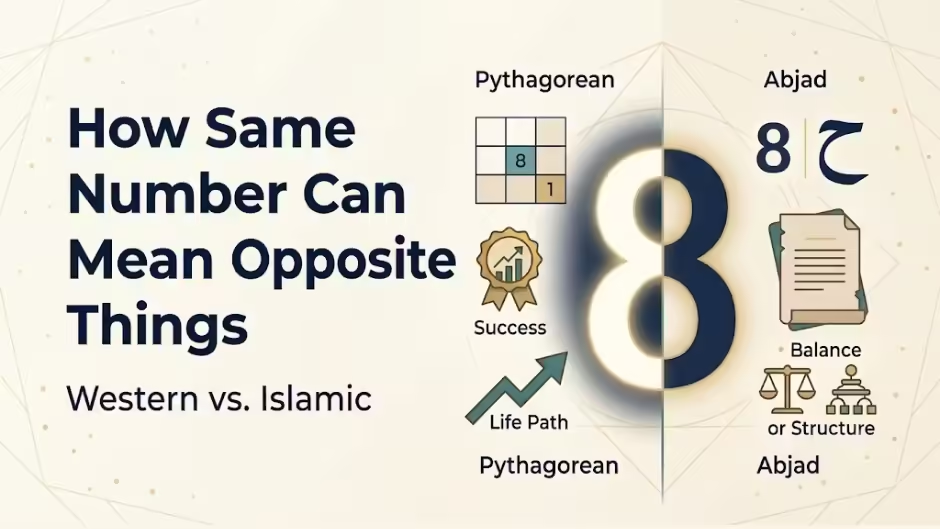
If you've ever looked up a number's meaning and found completely opposite answers on different websites, you're not confused and you're not reading bad sources. The number 8 is genuinely considered a symbol of great wealth and success in one tradition, a number associated with hardship and delay in another, and a deeply sacred number in a third. Same digit, three different verdicts. This happens because numerology is not one unified system. It is a family of distinct intellectual traditions that developed independently, each with its own mathematical logic, cultural roots and symbolic vocabulary.
Different numerology traditions assign meaning to numbers through different methods. Western Pythagorean numerology reduces birth dates and names to single digits and interprets them through planetary and philosophical associations going back to ancient Greece. Islamic Abjad and Jafar traditions derive numerical values from Arabic letter weights and interpret totals through cosmological frameworks rooted in medieval Islamic scholarship. Vedic numerology links numbers to planetary rulers from Jyotish astrology. Chinese metaphysics assigns fortune based on phonetic similarity to auspicious or inauspicious words in Chinese. The same number enters each system carrying a completely different set of associations.
The Number 8: A Case Study in Contradiction
Take 8 as a concrete example because it shows the divergence most clearly.
In Chinese numerology and feng shui, 8 is arguably the most coveted number in existence. Its pronunciation in Mandarin (ba) sounds similar to the word for prosperity and flourishing. This is why the 2008 Beijing Olympics opening ceremony was scheduled to begin at 8:08 pm on 08/08/2008. Families pay significant premiums for phone numbers, addresses and license plates containing multiple 8s. The association is phonetic and cultural, not mathematical.
In Western numerology, 8 is ruled by Saturn and traditionally associated with ambition, material mastery, authority and long-term achievement. It's considered a powerful number, but one that demands discipline. It is neither simply lucky nor unlucky. It rewards effort and carries a weight of responsibility. People with 8 as a Life Path or name number are often described as natural executives who face significant tests before reaching their goals.
In Vedic numerology, 8 is also Saturn-ruled (Shani), but Saturn in Jyotish carries a heavier karmic connotation than in Western systems. The number is often associated with delays, obstacles and lessons that must be worked through. A Bhagyank (destiny number) of 8 is sometimes called demanding rather than fortunate, though later-life achievement is also part of its traditional reading. This is not superstition. It reflects a different philosophical framework about how karma and planetary energy manifest over a lifetime.
In Islamic Abjad tradition, the number 8 does not carry a single fixed meaning in isolation the way Western numerology treats single digits. Meaning is derived from the total Abjad value of a name or word, and interpretation draws on the broader Jafar system of elemental and planetary correspondences. The letter Ha (ح) carries an Abjad value of 8 in the Kabir system, and it is associated with elemental water in certain classical texts. But the significance of any total number depends heavily on the full calculation and the purpose of the inquiry.
Why This Divergence Happens (and Why It's Not a Problem)
These traditions were never meant to be merged into a single universal key. They each emerged from specific intellectual and cultural contexts.
The Pythagorean approach grew from Greek philosophical ideas about numbers as fundamental principles of reality. The Islamic Abjad system developed from Arabic grammatical and phonetic scholarship, with strong influence from mathematical traditions in medieval Baghdad and Persia. Vedic numerology is inseparable from Jyotish, where numbers represent planetary energies whose qualities are described in Sanskrit texts spanning millennia. Chinese numerology is primarily phonetic and regional, varying even between Mandarin, Cantonese and other dialects.
This is also why mixing traditions in a single reading produces unreliable results. If you calculate your name number using Abjad letter values and then apply Western Pythagorean meanings to that total, you're essentially translating a sentence from Arabic into French and then reading it as if it were Spanish. The mechanics may look similar but the interpretive framework is entirely different.
Historical Context Worth Knowing
The formal documentation of letter-to-number correspondence in Arabic scholarship can be traced to texts like the Rasail Ikhwan al-Safa (Epistles of the Brethren of Purity), compiled in Basra in the 10th century CE. These encyclopaedic works explicitly connected Abjad letter values to cosmological and elemental categories. The system was treated as a branch of mathematical linguistics, not theology, and was studied alongside philosophy, music theory and geometry. This grounding in scholarly tradition is why modern Abjad practice is best understood as a continuation of classical Islamic intellectual tradition rather than as folk belief.
How to Actually Use This When You're Searching for Answers
The practical consequence of all this is simple: before you interpret any number in your life, identify which tradition's framework you're working within and stay inside it.
If you're coming from an Islamic cultural background and want to understand what a number traditionally signifies within that framework, the Islamic Lucky Number Calculator applies Abjad-based methodology to give you a tradition-specific result rather than a blended one. It draws on the same cosmological logic described in classical Abjad and Jafar texts rather than mixing in Western planetary associations.
If you want to understand a specific Arabic or Quranic word's numerical value within its own linguistic system, the Quranic Word Abjad calculator handles that calculation precisely, using the correct Kabir or Saghir letter values rather than approximating from transliteration.
For anyone exploring compatibility specifically within an Islamic Abjad framework (whether for sibling names, family naming patterns or relational harmony), the Sibling Name Compatibility calculator applies the same tradition-consistent methodology to name comparisons.
And if you're drawn to the deeper spiritual and cosmological dimension of Islamic numerology rather than just lucky numbers, the Roohaniyat Guide situates number values within the broader framework of Islamic esoteric tradition, which connects Abjad totals to elemental, planetary and spiritual categories as understood in classical texts.
For those coming from a Vedic background, the contrast with Islamic or Western readings of the same number can be striking. If you haven't already, it's worth reading about how Vedic numerology approaches compatibility as an illustration of how thoroughly planetary associations shape meaning within that system, even when the same digit appears in both a Vedic and a Western reading.
A Quick Reference: How Three Traditions Read Selected Numbers
| Number | Western (Pythagorean) | Vedic (Jyotish-linked) | Chinese (phonetic) |
|---|---|---|---|
| 4 | Stability, foundation, hard work | Ruled by Rahu, often associated with instability or disruption | Considered very inauspicious (sounds like "death" in Mandarin) |
| 8 | Saturn, ambition, material mastery | Saturn, delays, karmic lessons, later-life achievement | Highly auspicious (sounds like "prosperity") |
| 9 | Completion, humanitarianism, wisdom | Ruled by Mars, energy, leadership, courage | Auspicious (sounds like "long-lasting") |
| 6 | Nurturing, responsibility, family | Ruled by Venus, harmony, beauty, relationships | Generally neutral to slightly positive |
The table is not exhaustive. It illustrates how a number's traditional meaning shifts dramatically depending on the interpretive lens applied, which is exactly why knowing your tradition before reading a result matters so much.
Things People Wonder About Number Meanings Across Traditions
Why does the same number mean something lucky in one tradition and unlucky in another?
Because numerology traditions developed independently in different cultures, each with its own symbolic logic. Western Pythagorean numerology assigns meaning through philosophical and planetary associations from ancient Greece. Chinese numerology is primarily phonetic, where a number's fortune depends on how its name sounds in a specific Chinese dialect. Vedic numerology links numbers to Jyotish planetary rulers with their own karmic qualities. There is no universal number meaning that crosses all systems. The divergence is a feature of distinct intellectual traditions, not an error in any of them.
Is it valid to combine, say, Abjad numerology and Western numerology in one reading?
Most practitioners within each tradition advise against mixing systems, because each tradition's meanings are built on a coherent internal logic. Using Abjad letter values to get a number and then applying Western Pythagorean interpretations to that number is methodologically inconsistent. The Abjad system interprets totals through Islamic cosmological categories (elements, planets as described in classical Arabic texts), while Western numerology uses Greek and later Renaissance philosophical frameworks. The same total number carries different significance in each framework. For reliable results, choose one tradition and apply it consistently throughout your reading.
Does Islamic Abjad numerology assign lucky and unlucky meanings to individual digits the way Western numerology does?
Not in the same way. Classical Abjad and Jafar practice interprets the total numerical value of a name or word in relation to elemental and planetary correspondences described in medieval Islamic scholarship, not through a fixed list of meanings attached to digits 1 through 9. The significance of a total number depends on the purpose of the calculation (name selection, date evaluation, relational compatibility) and the specific sub-system used (Kabir or Saghir values, Jafar cosmological tables). Single-digit lucky number associations do exist in folk practice, but they are not the same as the formal Abjad calculation system.
How many numerology traditions are currently available to explore on this site?
This site currently covers 12 traditions across 200+ free calculators. These include Islamic Abjad and Jafar (25 calculators), Vedic Numerology (15), Western Numerology (26), Chaldean Numerology (8), Jewish and Kabbalah (9), Chinese Astrology and Metaphysics (15), Greek Isopsephy (7), Modern Numerology and Matrix (16), World Traditions and Symbolic Systems (9), Number Tools and Converters (14), Astrology covering both Western and Vedic approaches (56), and Divination and Symbolic (8). Each category applies its own tradition-specific methodology rather than a blended approach.
This article explores number meanings as they appear in historical numerology traditions and cultural practices from different parts of the world. It is intended as educational and cultural commentary only, and does not constitute religious guidance, spiritual advice or predictions of any kind.