
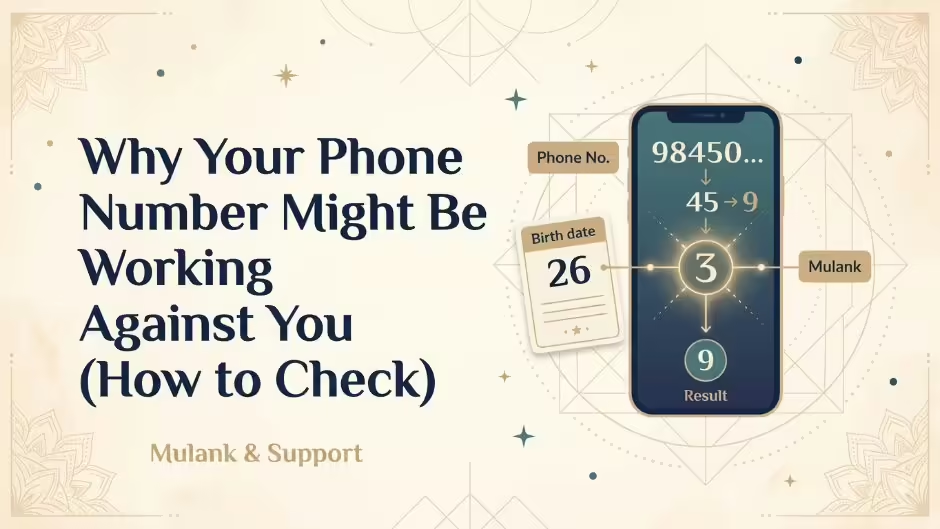
You probably chose your phone number because it was available, or because your carrier assigned it. Maybe you kept it through a move or a job change simply out of habit. That is completely normal. But in Vedic numerology, practitioners have long argued that the digits in your mobile number add up to a single planetary value, and that value either reinforces your personal energy or subtly opposes it. Most people never think to check. Some who do find the exercise genuinely eye-opening.
This page walks you through the full method: where the idea originates, how the calculation works, which number combinations are considered supportive or tense, and what you can realistically do with that information. There is also a worked example using a real scenario, plus notes on a common mistake that throws off the whole result.
The Tradition Behind the Idea
Vedic numerology draws on a body of knowledge called Anka Shastra, which assigns each digit from 1 to 9 a ruling planet inherited from classical Jyotish (Indian astrology). The assignments are as follows:
- 1 is governed by the Sun
- 2 is governed by the Moon
- 3 is governed by Jupiter
- 4 is governed by Rahu
- 5 is governed by Mercury
- 6 is governed by Venus
- 7 is governed by Ketu
- 8 is governed by Saturn
- 9 is governed by Mars
These planetary associations appear in Sanskrit texts spanning several centuries, and the principle that numbers carry planetary energy runs through both Jyotish and the related tradition of Vastu Shastra. Applying this logic to telephone numbers is a modern extension of those older ideas, one that became popular in India from the late twentieth century onward as mobile phones entered everyday life. It is not a religious teaching, but a cultural and interpretive framework rooted in classical Indian mathematical thinking.
How the Calculation Actually Works
The method has two parts: finding your phone number's root value, and finding your Mulank. Once you have both, you compare them against a compatibility table.
Step 1: Reduce Your Phone Number to a Single Digit
Take every digit in your local subscriber number (more on why "local" matters shortly) and add them all together. If the total has two digits, add those two digits together. Keep going until you reach a single digit between 1 and 9. That is your phone number's root value.
Worked example: Say your number is 9845 067 123. You add every digit: 9 + 8 + 4 + 5 + 0 + 6 + 7 + 1 + 2 + 3 = 45. Then 4 + 5 = 9. Your phone number's root value is 9, traditionally associated with Mars.
Step 2: Find Your Mulank
Your Mulank is your birth-day number, reduced to a single digit. It uses only the day of the month you were born, not the full date. If you were born on the 28th, you calculate 2 + 8 = 10, then 1 + 0 = 1. Your Mulank is 1, governed by the Sun.
If you would rather not do either reduction by hand, the Lucky Mobile Number Calculator runs the full compatibility check instantly, and the Mulank Calculator confirms your personal root number if you are unsure of the steps.
The One Mistake That Skews Everything
Before you look at the compatibility table, there is a common error worth flagging: including your country code in the digit sum. Many people automatically type their full number with the +91 or +1 prefix, add all those digits together, and get a root value that does not match the standard Vedic compatibility framework at all.
The tradition uses only your local subscriber number, the digits you actually share with contacts in your own country. Leave the country prefix out entirely. Whether your local number is ten digits or eleven, use only those digits and you will get the result the method intends.
Which Combinations Are Considered Supportive
Once you have both numbers, the comparison is straightforward. Vedic numerology groups the nine planetary numbers into friendly, neutral and tense pairings based on the classical planetary friendship charts from Jyotish. The table below summarises the traditional associations most commonly cited by practitioners.
| Your Mulank | Ruling Planet | Supportive Phone Root Numbers | Numbers to Approach Carefully |
|---|---|---|---|
| 1 (Sun) | Sun | 1, 2, 3, 9 | 6, 8 |
| 2 (Moon) | Moon | 1, 2, 3, 7 | 8, 9 |
| 3 (Jupiter) | Jupiter | 1, 3, 6, 9 | 8 |
| 4 (Rahu) | Rahu | 4, 5, 7, 8 | 1, 2 |
| 5 (Mercury) | Mercury | 4, 5, 6, 9 | None traditionally noted |
| 6 (Venus) | Venus | 3, 5, 6, 9 | 1, 8 |
| 7 (Ketu) | Ketu | 2, 4, 7 | 9 |
| 8 (Saturn) | Saturn | 4, 5, 8 | 1, 2, 3 |
| 9 (Mars) | Mars | 1, 3, 5, 6, 9 | 7 |
Keep in mind that different practitioners sometimes weight these pairings slightly differently. The table above reflects the most widely cited version of the framework and is best treated as a strong starting reference rather than an unchangeable rule.
A Realistic Scenario
Priya is a freelance consultant born on the 17th of the month. She reduces that to 1 + 7 = 8, giving her a Mulank of 8, governed by Saturn. She has been on the same number for three years and notices her client calls often end without a clear outcome, conversations that feel fine in the moment but somehow do not convert.
She runs her number through the digit reduction and gets a root value of 1, governed by the Sun. Looking at the table, Mulank 8 and phone root 1 sit in a tense pairing. In classical Jyotish, Saturn and the Sun are traditionally considered natural adversaries.
She is not about to upend her life over a compatibility table, but she does request a new SIM from her provider and asks specifically for a number whose digits sum to 4, 5 or 8, all of which are considered supportive for Saturn-ruled energy. Two months later she feels the calls go more smoothly. That is a personal anecdote, not a controlled study, but it illustrates how people are genuinely applying this framework in practical decisions.

Going Further: Name Numbers and Broader Compatibility
Some practitioners do not stop at the Mulank. They also cross-reference the phone number's root value against the person's name number, calculated from the letters of their name using the Chaldean-influenced letter-value grid used in Vedic practice. The idea is that all three values (name, birth day and phone number) should sit in a harmonious grouping for the best overall effect.
If you want to check whether your name and Mulank align alongside your phone number, the Vedic Name Number Calculator handles the name side of the equation. For a broader look at how numerological values relate between two people, the guide on Vedic numerology compatibility covers that territory in detail.
This site offers more than 200 free numerology, astrology and divination calculators across 12 traditions, including 15 dedicated to Vedic numerology specifically, so there are plenty of related tools to explore once you have your root numbers in hand.
Note: all Vedic numerology tools on this site reflect traditional belief systems and interpretive frameworks. They are not intended as scientific measurement tools, and results should be read in that spirit.
A Few Questions Worth Answering
Do I include the country code when calculating my phone number's root value?
No. Vedic numerology practitioners traditionally use only the local subscriber number, meaning the digits you share with contacts in your own country, without the international dialing prefix. Including the country code changes the final root value and produces a result that does not match the standard compatibility framework.
What is a Mulank and how is it different from a Life Path number?
Your Mulank is derived solely from the day of the month you were born, reduced to a single digit. It is a Vedic numerology concept tied to the planetary rulerships of Anka Shastra. A Life Path number, used in Western numerology, is calculated from your full date of birth (day, month and year all combined). The two systems use different source material and different interpretive traditions, so they will not always produce the same digit.
What should I do if my phone number's root value falls in the "approach carefully" column?
The tradition does not suggest anything drastic. Many practitioners recommend first checking whether a number change is practical, and if it is, requesting a new number from your provider and using the digit reduction method to pre-check whether the new number's root value is supportive. If changing numbers is not an option, some practitioners work with name adjustments or other complementary tools instead. Treat any decision as one input among many, not a directive.
Can I apply this method to a business phone number, not just a personal one?
Yes, practitioners often apply the same reduction method to business numbers, typically comparing the phone root value against the numerological value of the business name or the owner's Mulank. The logic follows the same framework: a root value that aligns with the ruling planet of the business name or its owner is traditionally considered more supportive for professional communication and deal-making.