
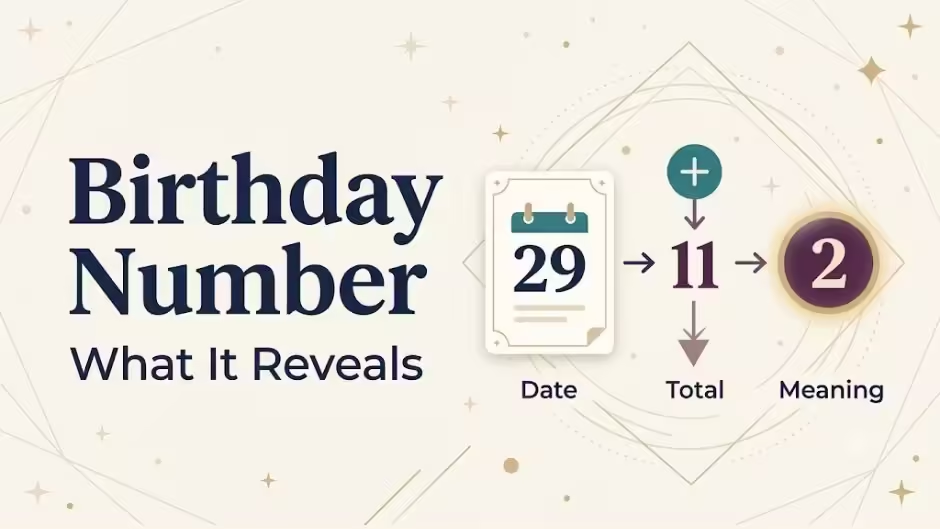
Most people look at their birthday and see a date. Vedic numerology sees something else: two distinct numbers compressed into that single day, each describing a different layer of who you are and where your life tends to go. Understanding both, and the difference between them, gives you a far more specific picture than any single-number system can.
Two Numbers, Not One: The Core Vedic Distinction
Western numerology typically produces one life path number from your full birth date. The Vedic system draws a more precise distinction by separating who you are by temperament from who you are shaped to become over time.
The first number is called the Mulank, sometimes written as Moolank or referred to as the root number. It comes from the day of the month alone and is traditionally associated with your instinctive character, the energy you express naturally and the impression you tend to make on others without consciously trying.
The second number is the Bhagyank, or destiny number. It uses your complete date of birth and is linked to the broader opportunities, obstacles, and recurring themes that shape your lifetime. Think of Mulank as the frequency you broadcast, and Bhagyank as the deeper current running underneath, pulling you toward certain kinds of experiences regardless of your day-to-day intentions.
This is why two people born in the same month and year can share an identical Bhagyank but feel like completely different people personally. Their long-term life themes may rhyme, but their instinctive character is entirely its own thing.
How to Calculate Each Number
Both calculations use simple addition and reduction to a single digit. Here is exactly how each one works.
Mulank: Your Day of Birth Only
Take the day of the month you were born. If it is already a single digit (1 through 9), that is your Mulank. If it is a two-digit number, add the digits together. If the result is still two digits, add again. Keep going until you reach one digit.
Example: Born on the 29th. 2 + 9 = 11. 1 + 1 = 2. Your Mulank is 2.
Bhagyank: Your Full Birth Date
Write out your complete birth date as individual digits, including the day, month, and all four digits of the year. Add every digit together, then reduce the total until you arrive at a single number.
Example: Born on 7 March 1985. The digits are 0, 7, 0, 3, 1, 9, 8, 5. Adding them: 0 + 7 + 0 + 3 + 1 + 9 + 8 + 5 = 33. Then 3 + 3 = 6. Your Bhagyank is 6.
You can calculate both numbers instantly using the Vedic Mulank root number calculator and the Bhagyank destiny number calculator. Both are free and part of the site's collection of 200+ numerology, astrology, and divination calculators spanning 12 traditions.
A Worked Example: Seeing Both Numbers Together
Take someone born on 19 August 1990. They have always felt a tension between wanting independence and being drawn toward collaborative work. Friends describe them as quietly forceful, someone who leads without making a production of it.
Mulank calculation: The day is 19. 1 + 9 = 10. 1 + 0 = 1. Mulank is 1.
In Vedic numerology, a Mulank of 1 is traditionally associated with solar energy, individual drive, and a strong instinct to initiate. That "quietly forceful" quality fits the description closely.
Bhagyank calculation: The full date 19 August 1990 gives digits 1, 9, 0, 8, 1, 9, 9, 0. Adding them: 1 + 9 + 0 + 8 + 1 + 9 + 9 + 0 = 37. Then 3 + 7 = 10. Then 1 + 0 = 1. Bhagyank is also 1.
Having the same number at both levels is relatively uncommon. It is generally read as a life strongly oriented around self-reliance, originality, and pioneering situations. The tension this person feels between independence and collaboration is not a contradiction in their chart. It is the same number expressing itself at two different depths, one instinctive and one structural.
What Each Number Traditionally Suggests
The table below summarises the traditional associations for each number in both positions. These reflect classical Vedic interpretive frameworks, not deterministic predictions.
| Number | Mulank qualities (often associated with) | Bhagyank themes (traditionally linked to) |
|---|---|---|
| 1 | Leadership, initiative, independence | Pioneering paths, originality, self-made situations |
| 2 | Sensitivity, diplomacy, receptivity | Partnerships, mediation, patient accumulation |
| 3 | Creativity, expression, sociability | Communication, artistic growth, public roles |
| 4 | Discipline, practicality, reliability | Building foundations, structured effort |
| 5 | Curiosity, adaptability, restlessness | Change, travel, varied experiences |
| 6 | Nurturing, responsibility, harmony | Home, family, service-oriented paths |
| 7 | Introspection, analysis, intuition | Research, spiritual inquiry, specialised knowledge |
| 8 | Ambition, authority, material focus | Power, large-scale achievement, karmic tests |
| 9 | Compassion, idealism, broad vision | Completion, humanitarian roles, universal themes |
The Historical Background Behind These Numbers
The Mulank and Bhagyank system belongs to the broader tradition of Vedic or Indian numerology, which draws on ancient Sanskrit texts and was historically practiced alongside Jyotish (Vedic astrology). Scholars trace the systematic numerical symbolism in Indian thought to at least the early medieval period, with roots in a philosophical framework called anka shastra, meaning the study of numbers as carriers of cosmic significance.
The planetary associations tied to each digit, with the Sun governing 1, the Moon governing 2, Jupiter governing 3, and so on through the classical planets, reflect this Jyotish connection directly. They help explain why the tradition treats birth numbers as temperamental rather than merely mathematical. Each digit is, in this framework, a kind of planetary fingerprint embedded in the date.
The Most Common Calculation Mistakes
The single biggest error is using your full birth date to calculate both numbers. Mulank uses the day only. If you feed the complete date into both calculations, you will get identical results for both numbers and miss the entire point of having two separate figures.
The second common mistake is stopping the reduction too early. Some Western systems preserve certain compound numbers as "master numbers" (11, 22, 33), but classical Vedic numerology typically reduces all the way down to a single digit for both Mulank and Bhagyank. If you are using a Vedic framework and your intermediate total is 11 or 22, keep going: 1 + 1 = 2, 2 + 2 = 4.
What Happens When You Add Your Name
Many Vedic practitioners also calculate a name number to see whether it harmonises with the Mulank. The underlying logic is that your birth date is fixed and reveals your natural character, while your name, which can in principle be adjusted, represents something more malleable. When a name number and Mulank are considered compatible in the tradition, the person is thought to express their core qualities more freely. When they conflict, the name is sometimes adjusted, particularly for newborns, as a way of supporting the birth chart rather than working against it.
This is an interpretive tradition, not a scientific one. The associations described here reflect centuries of practice and classical texts. They are not predictive in any verifiable sense.
People Also Ask
What is the difference between Mulank and Bhagyank?
Mulank is calculated from the day of birth only and is traditionally associated with your instinctive personality and how others naturally perceive you. Bhagyank uses your full birth date (day, month, and year) and is linked to the broader themes, opportunities, and patterns that tend to shape your life over time. Using the full date for both calculations is a common error that produces two identical numbers and loses the distinction entirely.
Can my Mulank and Bhagyank be the same number?
Yes, it does happen, though it is relatively uncommon. When both numbers match, the tradition generally reads this as a life where the instinctive character and the longer-term life path are strongly aligned, both pointing in the same direction. The worked example on this page (born 19 August 1990) is one such case, where both numbers reduce to 1.
Does Vedic numerology reduce master numbers like 11 or 22?
Classical Vedic numerology typically does reduce compound numbers all the way to a single digit. So if your intermediate total is 11, you would continue: 1 + 1 = 2. The concept of preserving master numbers (11, 22, 33) is more common in Western Pythagorean numerology than in the Vedic tradition.
Is there scientific evidence behind birthday numerology?
No. Vedic numerology, including the Mulank and Bhagyank system, reflects a historical and philosophical tradition rather than an empirically tested science. The associations described here are drawn from classical Vedic texts and interpretive practice. They offer a framework for self-reflection, not verifiable predictions.