
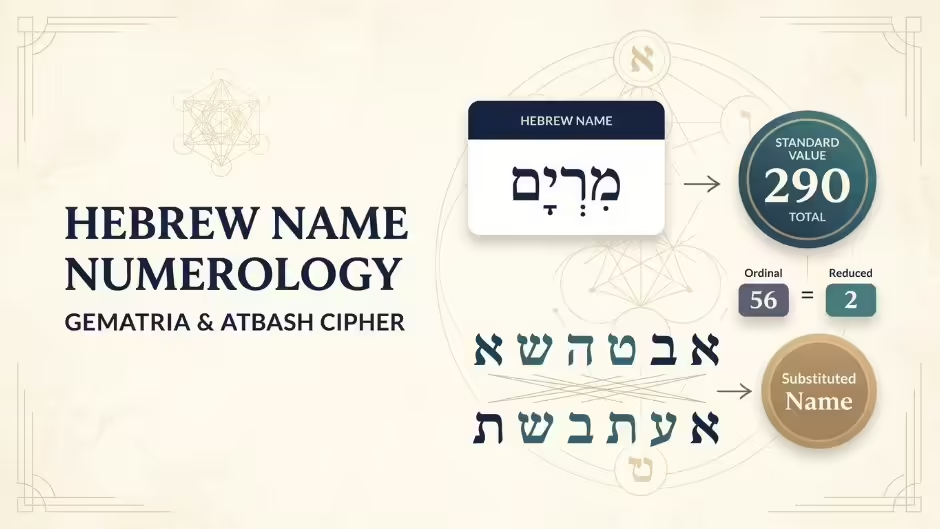
Maybe you spotted your Hebrew name on a family document, heard it called out at a lifecycle ceremony, or traced it through synagogue records. However you found it, you're now asking a deeper question: does this name carry meaning beyond its translation? In Jewish mystical tradition, the answer is almost certainly yes. The practice used to explore that meaning is called Gematria, and this guide walks you through exactly how it works, which method suits name analysis, and how to make sense of your result in a way that's genuinely useful rather than just arithmetically interesting.
A Framework Two Millennia in the Making
Gematria is not a modern wellness trend. The term appears in the Talmud, compiled between the 3rd and 6th centuries CE, though scholars trace the underlying practice to the Second Temple period and possibly to earlier Mesopotamian numerological traditions. The Sefer Yetzirah (Book of Formation), composed around the same era, formalised the relationship between Hebrew letters and numbers and gave Gematria its central role in Kabbalistic interpretation.
The Atbash cipher is older still, appearing directly in the Hebrew Bible. In the Book of Jeremiah, the word "Sheshach" is widely understood by scholars to be an Atbash encoding of "Babel," making letter-substitution one of the earliest documented forms of Hebrew wordplay and hidden meaning. Knowing this background changes how you read your results: you're not engaging with a self-help system invented last decade. You're touching a framework that scribes, mystics and scholars have used for over two thousand years.

Three Ways to Calculate a Name's Value
Most people assume there's one single method for working out a Hebrew name's number. There are actually three meaningfully different approaches, and each one asks a slightly different question. Running all three and noticing where they converge is often more revealing than picking just one.
1. Ordinal Gematria (Positional Value)
Here, each letter is valued by its position in the Hebrew alphabet. Aleph, the first letter, equals 1. Bet equals 2. The count runs through all 22 letters, ending with Tav at 22. The arithmetic is straightforward, and the results are easy to compare across names. This method is particularly suited to positional readings, ones that reflect where each letter sits within the alphabet's structure rather than its traditional numerical weight.
2. Standard Gematria (Absolute Value, or Mispar Hechrachi)
This is the classical system, and the one most commonly referenced in Kabbalistic texts. Instead of a simple 1-to-22 sequence, the values scale in magnitude. The first nine letters (Aleph through Tet) run from 1 to 9. The next nine (Yod through Tzadi) run from 10 to 90 in increments of ten. The final four (Qof through Tav) run from 100 to 400. A name calculated this way produces a much larger number, which Kabbalistic readers then compare against other Hebrew words or phrases sharing the same total, looking for what the tradition considers embedded thematic connections in scripture.
3. Reduced Gematria (Single-Digit Root Value)
Reduced Gematria takes whatever total you've reached (from ordinal or standard values) and collapses it to a single digit through repeated digit-sum reduction. If your ordinal value is 56, you add 5 and 6 to get 11, then add 1 and 1 to arrive at a root of 2. This root number is often the most practical when comparing names or relating a name to specific Kabbalistic concepts, because it strips away magnitude and reveals what the tradition considers the name's core numerical essence.
None of these methods is more authoritative than the others. They simply answer different questions about the same name.
Worked Example: Calculating the Name Miriam
Let's make this concrete before you apply it to your own name. The Hebrew spelling of Miriam is Mem, Resh, Yod, Mem (מִרְיָם).
Ordinal Gematria
- Mem is the 13th letter: 13
- Resh is the 20th letter: 20
- Yod is the 10th letter: 10
- Mem (second): 13
- Ordinal total: 13 + 20 + 10 + 13 = 56
Reduced Gematria (from ordinal)
- 56: 5 + 6 = 11
- 11: 1 + 1 = 2
The number 2 is traditionally associated in Kabbalistic interpretation with duality, partnership and the feminine principle. That association is worth noting given Miriam's role in scripture, though the interpretation is qualitative, not predictive.
Standard Gematria
- Mem = 40
- Resh = 200
- Yod = 10
- Mem = 40
- Standard total: 40 + 200 + 10 + 40 = 290
A Kabbalistic reader would then search for other Hebrew words or scriptural phrases that also total 290 to identify what the tradition considers hidden correspondences.
You don't need to memorise any of these letter values to do this yourself. The calculators on this site handle the arithmetic the moment you enter your Hebrew text.
What the Atbash Cipher Adds to the Picture
Once you have a name's Gematria value, the Atbash cipher offers a completely different layer of insight. Rather than assigning numbers, Atbash substitutes each letter with its mirror opposite in the Hebrew alphabet. Aleph (first letter) becomes Tav (last letter). Bet (second) becomes Shin (second-to-last). The name "Atbash" encodes this logic in itself: Aleph-Tav, Bet-Shin.
The substitution produces a new sequence of Hebrew letters, which Kabbalistic readers interpret as a kind of shadow meaning or hidden parallel running alongside the original name. Sometimes the resulting string forms a recognisable Hebrew word. Other times the letters don't create a conventional word, but within Kabbalistic hermeneutics each substituted letter still carries its own symbolic weight, and the combination is treated as meaningful in its own right.
If you're researching your name seriously, running the Atbash transformation alongside a Gematria calculation gives you two different perspectives on the same name: one numerical, one substitutive. They often complement each other in ways that a single method alone wouldn't surface.
How to Actually Read Your Result
Getting a number or a substituted string is only the first step. Here's how to move from raw output to something genuinely interpretable.
- Compare across methods. If your ordinal, standard and reduced values all point toward themes of leadership, for example, that convergence is considered more significant than any single number in isolation.
- Look for Hebrew word matches. With your standard Gematria total in hand, search for other Hebrew words that share the same value. Traditional Kabbalistic analysis treats words with the same number as carrying related or complementary meanings, a principle called notarikon when applied to phrases.
- Treat the reduced root as a lens. Single-digit roots (1 through 9) each carry a body of traditional associations in Kabbalistic literature. Your reduced number positions your name within that symbolic vocabulary.
- Keep historical context in view. Gematria is a system of interpretation developed within a specific religious and literary tradition. Its results are best understood as culturally and spiritually meaningful rather than as factual claims about personality or destiny.
These calculators are offered as tools for personal exploration and cultural learning. The results reflect traditional Jewish mystical belief, not scientifically verified claims.
Where This Fits in the Wider Site
The Jewish and Kabbalah category on this site currently includes 9 calculators covering Gematria (ordinal, standard and reduced), Atbash, and related Hebrew letter tools. They sit alongside 200+ free numerology, astrology and divination calculators spanning 12 traditions, from Vedic and Chaldean numerology to Greek Isopsephy and Islamic Abjad systems. If you're curious how Hebrew Gematria compares to other letter-to-number traditions, the Greek Isopsephy and Abjad Kabir calculators are good starting points for comparison.
Questions People Often Ask About Hebrew Name Numerology
Do I need to know Hebrew to use the Gematria calculator?
Not necessarily. If you know the Hebrew spelling of your name (or can find it through a synagogue record, Hebrew name certificate, or standard reference), you can enter it directly. Many Hebrew names also have well-documented standard spellings you can copy. The calculator handles all the arithmetic once the text is entered.
Which Gematria method should I use for my name?
There's no single correct answer. Standard Gematria (Mispar Hechrachi) is the classical method most referenced in Kabbalistic texts and is a good starting point. Ordinal Gematria gives a simpler positional value, and Reduced Gematria produces a single-digit root that many people find easier to interpret and compare. Running all three and seeing where the results overlap tends to give the most rounded picture.
What's the difference between Gematria and the Atbash cipher?
Gematria converts Hebrew letters into numbers so names and words can be compared by their numerical totals. The Atbash cipher instead substitutes each letter with its alphabetical mirror (first letter for last, second for second-to-last, and so on), producing a new sequence of letters rather than a number. Both are used in Kabbalistic textual analysis, but they ask different questions and produce different kinds of output. Used together, they offer complementary angles on the same name.
Can Gematria tell me something definitive about my character or future?
No. Gematria is a system of interpretation rooted in Jewish mystical tradition, not a predictive or personality-assessment tool with empirical backing. The associations tied to specific numbers or letter substitutions are culturally and spiritually meaningful within that tradition, and many people find them thought-provoking, but they don't constitute factual claims about who you are or what will happen to you.