
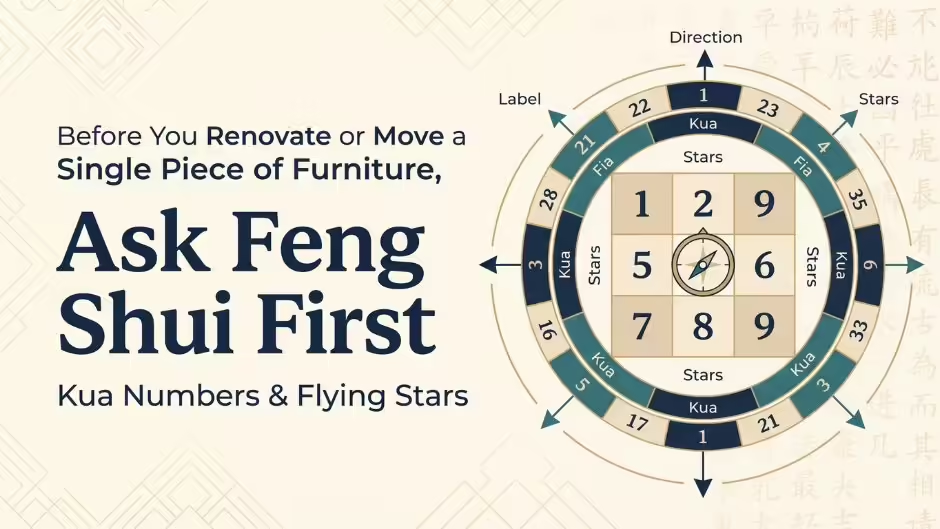
You've been staring at the same awkward corner for months. The sofa feels off. Your desk faces a wall that somehow kills your concentration. You've been half-planning a kitchen extension, but something keeps making you pause. In classical Chinese metaphysics, that hesitation can sometimes be answered with surprising precision: not all directions are energetically equal, and not all timing is neutral when it comes to construction.
Classical feng shui gives you two distinct lenses for making home decisions. One is personal, tied to your birth year. The other is structural, tied to the building itself and the era it sits in. Understanding both, and how they overlap, is what separates a genuinely informed home decision from a guess dressed up in good intentions.
Two Systems, One Purpose
The first lens is your Kua number, derived from the Eight Mansions (Ba Zhai) method. It tells you which compass directions support your health, relationships, wealth and personal growth, and which ones work against you. This number is personal: it follows you wherever you live.
The second lens is the Flying Star (Xuan Kong) system, which is structural. It maps a set of energy numbers (stars one through nine) onto the nine sectors of your home based on the building's facing direction, its sitting direction, and the 20-year period in which it was built or last significantly renovated. This energy map belongs to the building, not to you, and it shifts with each new period.
When you're deciding whether to renovate a specific part of your home, move your bedroom, or position your workspace, checking both systems together gives you a much fuller picture than either one alone.
Why the Timing of Renovation Actually Matters
Period 8 ran from 2004 to 2023. During that cycle, the most auspicious Flying Star energy was concentrated in the northeast and northwest sectors of most structures. Practitioners who opened up those areas, added windows there, or placed key rooms in those zones were said to be drawing on favorable qi. That 20-year window is now closed.
Period 9 began in February 2024 and runs through 2043. The dominant directional energy has shifted to the south. If you're planning a significant renovation in 2025 or any year beyond, working from a Period 8 chart is like navigating with last decade's map. The numbers have moved, and the recommendations that followed from them have moved with them.
This isn't abstract philosophy. The Flying Star system is fundamentally mathematical. Each sector of a building receives a combination of two stars, based on the home's facing and sitting directions and the active period. Those star combinations interact in ways that are either productive, neutral or conflicting. Knowing which sectors currently carry favorable combinations tells you where to focus new activity. Knowing which carry difficult combinations tells you where to avoid breaking walls, drilling or disturbing the ground, even when the practical case for doing so looks sound.
You can identify your property's current period and see how the energy distributes across its nine sectors by using the Flying Star (Xuan Kong) Period Calculator. It lays the foundation for understanding which areas of your home are energetically active right now.
A Quick Note on Period 9's Classical Associations
The Flying Star system as practiced today is largely attributed to master Shen Zhu-reng of the Qing dynasty, who systematized the Xuan Kong method in his treatise "Shen's Study of Xuan Kong." The 20-year period cycle itself derives from the 60-year Sexagenary Cycle used throughout East Asian metaphysics, with three sub-cycles of 20 years forming one larger 60-year pattern.
Period 9 is governed by the fire trigram (Li) and is traditionally associated in classical texts with visibility, intelligence and feminine leadership. This makes south-facing sectors and south-oriented activity particularly worth understanding for anyone planning significant changes between now and 2043.
Your Kua Number: The Personal Half of the Equation
The Kua number system divides people into two broad groups: East Group and West Group. Each group has four favorable directions and four unfavorable ones. Within those four favorable directions, each one is traditionally linked to a different area of life:
- Vitality direction: generally associated with health and physical wellbeing
- Wealth direction: traditionally linked to resources and financial opportunity
- Relationships direction: associated with harmony and romantic or family connection
- Growth direction: often connected to personal development, wisdom and clarity
For practical home planning, your Kua number is most useful when you're deciding where to position a bed headboard, which way your desk should face, or where you naturally sit at the dining table. Someone whose Kua number places wealth energy in the southeast should ideally face southeast when working. Someone whose relationship direction falls in the south benefits from a bedroom located in that part of the home.
One important technical detail: the Kua number is calculated from your birth year using the traditional Chinese lunar calendar, not the Gregorian calendar. If you were born in January or early February, your Chinese birth year may differ from your Gregorian birth year, which changes the result. The Kua Number Calculator handles that adjustment automatically and returns your four auspicious and four inauspicious directions.
A Real Planning Scenario: The Kitchen Extension Problem
Here's a practical example of how both systems can shape a real decision.
Imagine a household that wants to extend the kitchen northward into an adjacent garage space. On paper, it makes excellent practical sense: more room, better flow, natural light from a new window. But before committing to the build, it's worth checking the Flying Star chart.
In Period 8, the north sector of many properties carried a star combination that practitioners considered stable but not particularly active. In Period 9, the north receives a different star combination depending on the home's specific facing direction. For some homes, that new combination is what traditional practitioners describe as conflicting, associated with potential health disruptions. Breaking ground in that sector, even for a sensible practical reason, could mean disturbing an energetically sensitive area at a poor time.
The resolution isn't necessarily to abandon the project. It might be to map the Flying Star chart for that specific property, identify what the north sector is actually carrying in Period 9, and then decide with full information whether to proceed, delay until the timing shifts, or adjust the layout so the most disruptive construction falls in a different sector. If the household members' Kua numbers also point away from the north as an auspicious personal direction, that adds further weight to reconsidering the plan.
When the Two Systems Reinforce Each Other
The Kua and Flying Star methods aren't redundant. They're asking different questions. The Kua system asks: which directions support this particular person? The Flying Star system asks: which sectors of this building are energetically favorable right now?
The most favorable scenario is when your personal auspicious directions (from your Kua number) overlap with the sectors that the current Flying Star chart marks as active and favorable for your home. When those two things align, you've found the most supported spot for a key room, a workstation, or a bed placement.
When they conflict, you make a judgment call. In general, practitioners tend to prioritize the Flying Star chart for renovation timing and room designation, and the Kua number for furniture orientation and sleeping direction within a room. But neither system overrides the other entirely, and a skilled practitioner weighs both.
How to Start Applying This at Home
You don't need to hire a consultant to get useful information from these systems. A sensible starting sequence looks like this:
- Calculate your Kua number and note your four auspicious directions. The Kua Number Calculator takes your birth year and sex and returns your directions with their associated life areas.
- Identify your home's facing direction and the period it was built or last significantly renovated. Use the Flying Star Period Calculator to orient yourself within the current 20-year cycle.
- Overlay what you find. Where do your personal auspicious directions land in the Flying Star map? Are those sectors active and favorable, or are they carrying difficult star combinations right now?
- Use that combined picture to decide: which rooms are worth activating, which renovation can proceed, and which project is worth delaying or redesigning.
This site offers over 200 free numerology, astrology and divination calculators spanning 12 traditions, including 15 tools in the Chinese Astrology and Metaphysics category alone. The Kua and Flying Star calculators are part of that collection and are a practical entry point for anyone applying classical feng shui to real home decisions.
A Few Things Worth Knowing Before You Rely on These Systems
Both the Kua number system and the Flying Star method are rooted in classical Chinese metaphysics with centuries of practitioner tradition behind them. They offer a coherent internal logic and many people find them genuinely useful as a framework for home planning. That said, they reflect traditional belief and cultural practice, not scientifically verified cause and effect. Use them as an additional layer of consideration alongside practical, structural and financial factors, not as a substitute for those things.
Questions People Ask About Feng Shui and Home Planning
Does my Kua number change if I move to a different house?
No. Your Kua number is fixed to your birth year and doesn't change with your address. What changes when you move is the Flying Star chart, which belongs to each individual building. Your personal auspicious and inauspicious directions stay the same wherever you live; you simply apply them to the layout of the new space.
What counts as a renovation significant enough to reset the Flying Star period?
Classical practitioners generally consider a property to have entered a new period when major structural work takes place, typically defined as work involving the roof or load-bearing walls. Repainting, reflooring or updating fixtures usually doesn't reset the period. Building an extension that significantly changes the structure of the home is more ambiguous and worth consulting a practitioner about if you want a precise answer for your specific property.
If my Kua number and the Flying Star chart point in different directions, which one wins?
There's no single rule that always applies, but a common practitioner approach is to let the Flying Star chart guide room-level decisions (which rooms to activate, which sectors to avoid disturbing in a renovation) while using the Kua number to guide orientation within a room (which way the bed headboard faces, which direction you sit at your desk). When both systems agree on a direction, that agreement carries more weight than either one pointing there alone.
Can feng shui analysis override a good structural or financial reason to renovate?
It shouldn't, and most serious practitioners don't present it that way. The framework is most useful as an additional filter, helping you choose between options that are otherwise roughly equal, or suggesting you adjust the scope or timing of a project rather than abandon it entirely. A feng shui reading that advises you to ignore a serious structural problem or a compelling financial opportunity is overstepping what the system is designed to do.