
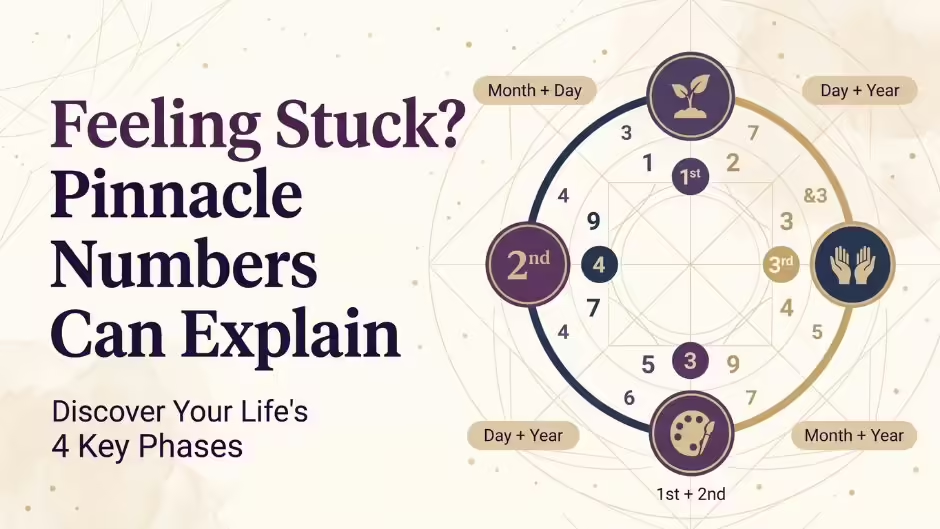
There's a particular kind of restlessness that's hard to name. You're not miserable, not lost exactly, but life feels like it's idling when it should be in gear. You're doing the right things, checking the right boxes, and still something feels off. Western numerology has a specific framework for this experience, and it centres on a system called Pinnacle Numbers.
The idea is straightforward: your life unfolds across four broad phases, each carrying its own dominant energy, its own demands and its own invitation. Knowing which phase you're currently in, and how long it runs, can reframe that vague frustration into something you can actually work with.
Why Some Periods of Life Feel Unmistakably Different
Most people can look back and identify a stretch of time that felt genuinely unlike what came before it. A period of unusual clarity, a forced reinvention, or a long plateau that seemed to have no obvious cause. In the Western Pythagorean numerology tradition, these shifts are often understood as Pinnacle transitions, points where one phase ends and a new energy takes over.
The four Pinnacle cycles aren't equal in length, and that's part of what makes the system interesting. The first cycle runs from birth up to an age that depends on your Life Path number, typically somewhere between the late twenties and mid-thirties. The second and third each cover roughly nine years. The fourth runs from the close of the third cycle through to the end of life.
This is why someone at 31 and someone at 55 might both describe feeling like they're "between chapters." They may genuinely be at a transition point, and naming it can make an enormous difference.
A Familiar Scenario Worth Pausing On
Imagine someone in their late thirties who has spent several years building steadily. By most conventional measures, things look fine. But there's a quiet friction, a sense that none of it quite fits. They wonder if they chose the wrong direction entirely.
What they may not realise is that their second Pinnacle, which numerologists traditionally associate with partnership, collaboration and emotional development, is drawing to a close. The third Pinnacle, which tends to carry a more expressive and self-directed quality, is approaching. The restlessness isn't evidence of failure. It's the natural tension of one cycle winding down while another hasn't yet fully begun.
Recognising that pattern is exactly what the Pinnacle Numbers calculator is designed to help with. It takes your birth date, works through all four phase calculations and shows you which Pinnacle you're currently in, the number associated with it and the approximate age span it covers.

How Pinnacle Numbers Are Actually Calculated
The four Pinnacle numbers are derived from three components of your birth date: the month, the day and the year. Each is first reduced to a single digit (with 11, 22 and 33 preserved as master numbers in most Western traditions). Here's how each Pinnacle is formed.
- First Pinnacle: the reduced birth month plus the reduced birth day
- Second Pinnacle: the reduced birth day plus the reduced birth year
- Third Pinnacle: the sum of the First and Second Pinnacle numbers
- Fourth Pinnacle: the reduced birth month plus the reduced birth year
Each result is reduced to a single digit unless it lands on 11, 22 or 33. The age at which your first Pinnacle ends is calculated as 36 minus your Life Path number. So someone with a Life Path of 5 enters their second Pinnacle at age 31, while someone with a Life Path of 9 enters theirs at 27.
A Worked Example
Say someone is born on 14 March 1988. That breaks down as: month 3, day 14 (reduces to 5), year 1988 (1 + 9 + 8 + 8 = 26, reduces to 8).
- First Pinnacle: 3 + 5 = 8
- Second Pinnacle: 5 + 8 = 13, reduces to 4
- Third Pinnacle: 8 + 4 = 12, reduces to 3
- Fourth Pinnacle: 3 + 8 = 11 (master number, kept as 11)
If this person has a Life Path of 7, their first Pinnacle ends at age 29 (36 minus 7). From there, each subsequent cycle adds approximately nine years to the starting point.
The calculator handles all of this automatically. You enter your birth date, and it returns your current Pinnacle number, the age range it covers and a brief description of the energy traditionally associated with it.
What Each Pinnacle Number Is Traditionally Associated With
Each number from 1 through 9, plus the master numbers, carries a distinct character in the Pythagorean tradition. Here's a concise reference for reading your result.
| Pinnacle Number | Traditionally Associated With |
|---|---|
| 1 | Independence, self-determination, developing a clearer individual identity |
| 2 | Cooperation, sensitivity, patience and the deepening of relationships |
| 3 | Creative expression, social connection and communication |
| 4 | Building, discipline, practical foundations and sustained effort |
| 5 | Change, freedom, adaptability and varied experience |
| 6 | Responsibility, home, family and service to others |
| 7 | Inner development, study, solitude and deeper understanding |
| 8 | Ambition, material achievement and leadership |
| 9 | Completion, humanitarian focus and learning to let go |
| 11 | Heightened intuition, inspiration and idealism (master number) |
| 22 | Large-scale building and practical vision applied broadly (master number) |
It's worth noting that these associations reflect traditional belief within the Pythagorean numerology system, not scientifically verified outcomes. Think of them as a reflective lens rather than a prediction.
A Brief History of the System
The Pinnacle system sits within the Pythagorean numerology tradition, named after the Greek philosopher Pythagoras of Samos (approximately 570 to 495 BCE), who taught that number underlies all of reality. The formalised system used in English-language numerology today was shaped largely in the early twentieth century, most notably through the work of L. Dow Balliett and later Florence Campbell. Campbell's writings in the 1930s introduced structured life-phase frameworks, including cycle and Pinnacle models, that remain the foundation of modern Western numerology charts.
Reading Your Result in Context
The Pinnacle number you're currently in describes the conditions and demands that tend to show up around you during that phase. But how you respond to those conditions is shaped by who you are underneath the circumstances.
That's where a companion number becomes genuinely useful. The Soul Urge number (sometimes called the Heart's Desire) is derived from the vowels of your full birth name and is traditionally associated with your deepest motivations and intrinsic drives. If your current Pinnacle calls for partnership and collaboration but your Soul Urge strongly favours independence, you may experience the friction of that mismatch without ever quite naming it. Running both numbers together gives you a more layered picture. You can calculate yours with the Soul Urge Number calculator and compare it directly against what your current Pinnacle is asking of you.
If you've recently moved or are thinking about it, it's also worth noting that the numerological quality of your home address is traditionally understood to interact with your Pinnacle energy, sometimes supporting it and sometimes working against it.
Across this site's 26 Western Numerology calculators (part of a wider collection of 200+ free tools spanning 12 traditions), you'll find tools to explore all of these layers, from Life Path and Expression numbers through to Pinnacle and Personal Year cycles.
Common Questions About Pinnacle Numbers
Can two people have the same Pinnacle number but experience it very differently?
Yes, and that's expected within the system. The Pinnacle number describes the general quality of energy present during a phase, but how it plays out is shaped by other numbers in your chart, your circumstances and your personal choices. Someone moving through a 4 Pinnacle while their Soul Urge is also a 4 may find the period feels natural and productive. Someone whose Soul Urge is a 5 may find the same 4 Pinnacle feels restrictive. The number sets the stage; you determine what happens on it.
What if my Pinnacle number is the same across two consecutive phases?
This does happen, and numerologists traditionally interpret it as an extended period under the same broad influence rather than a simple repetition. The texture of each phase still differs because the surrounding cycle energies, your age and your life context all change. It can sometimes feel like a theme is being reinforced rather than resolved, which is worth reflecting on in its own right.
How is a Pinnacle Number different from a Personal Year Number?
They operate on very different timescales. A Personal Year Number shifts every calendar year and reflects the shorter rhythms of day-to-day life. A Pinnacle Number covers a span of roughly nine years or more and describes the broader backdrop of a whole life chapter. Think of the Pinnacle as the season and the Personal Year as the weather within that season. Both are useful, and they're best read together rather than in isolation.
Is there a master number 33 Pinnacle?
In most mainstream Western Pythagorean numerology, 33 is not used as a Pinnacle number because the arithmetic pathway rarely produces it from standard birth date components. Some numerologists working with extended master number systems do include 33, traditionally associating it with compassionate teaching and selfless service, but this is not part of the conventional Pinnacle framework used by most practitioners or by the calculator on this page.