
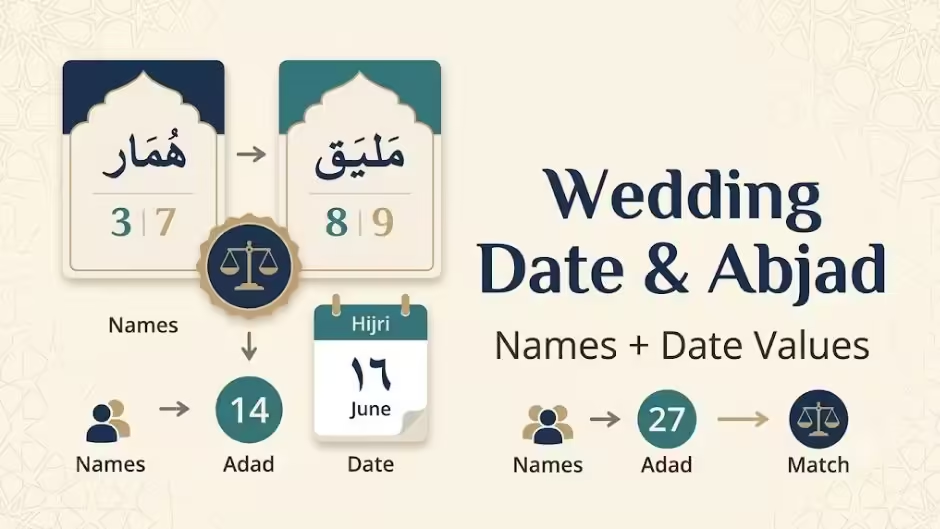
You've probably got a shortlist already. Two or three dates that tick the practical boxes: they fall on a weekend, they don't clash with Ramadan, and the in-laws can actually travel. But something still pulls at you. Which date is the right one? Across the Islamic world, families have used Abjad numerology for centuries as one way of thinking through exactly that question. It isn't a religious directive. It's a cultural and mathematical tradition built into Arabic literary and scholarly life, and it has a surprisingly structured method behind it.
This guide lays out that method clearly, including the historical context, a practical step-by-step process, a worked example with real numbers, and the most common mistakes worth avoiding before you start.
What Is Abjad Numerology and Where Does It Come From?
Abjad numerology assigns a specific numerical value to every letter of the Arabic alphabet. When you convert a name, a date written out in Arabic words, or a combination of both into their letter values and sum them, you get what practitioners call the hisab al-jummal, which translates roughly as "the calculation of the total." That single figure, or its reduced root digit, is then compared against other values to assess compatibility or resonance.
The system itself predates Islam. It traces back to Phoenician and early Semitic alphabets, where letters and numerals were the same characters. Arabic scholars later formalized two main variants that you'll encounter when using any Abjad tool:
- Abjad Kabir (the "greater" system) uses the traditional extended values based on letter position, so a letter like Qaf carries a value of 100, Ra carries 200, and Shin carries 300. This system is the one most commonly applied to names and significant life events.
- Abjad Saghir (the "lesser" system) reduces all values above nine to single digits, so Qaf becomes 1, Ra becomes 2, and Shin becomes 3. It's often used for quick compatibility comparisons.
Medieval Islamic scholars applied both systems across poetry, astronomy, and historical date-recording in verse. Neither variant is more authoritative than the other. They simply answer slightly different questions, and knowing which one you're using before you start is important because they produce different outputs from identical inputs.
If you want a fuller grounding in how the letter values work across both systems, the beginner's guide to Abjad numerology covers them side by side and is worth reading before you run any numbers.
The Problem Most Couples Actually Run Into
There's a pattern that comes up often. A couple picks a date based entirely on logistics, books the venue, and only much later wonders whether the numbers align. Or the reverse happens: they spend weeks calculating and end up stuck because they're unsure which system to use, whether to work with the Gregorian or Hijri date, and whether to calculate both names together or separately.
The section below cuts through that with a consistent, step-by-step approach you can apply to any shortlist of dates.
A Practical Method: Evaluating a Wedding Date Step by Step
Step 1. Write the Date Out in Arabic Words
This is where most people skip ahead and make an error. You can't plug a numeral like "15" into an Abjad calculator and expect a valid result. The system works on the Arabic letters themselves, so you need the date written out as words. The fifteenth of Rajab, for instance, becomes "khamsat 'ashar min Rajab." Each letter in each word carries a value, and you sum all of them to get the date's total.
Step 2. Choose Your System and Stick to It
Decide upfront whether you're using Abjad Kabir or Abjad Saghir, and apply that same system to every element of your calculation, both names and the date. Using the Abjad Kabir calculator gives you the full traditional values. If you prefer the reduced single-digit form, use the Abjad Saghir calculator instead. Many practitioners run both and compare the results, which is a reasonable approach as long as you don't mix values from one system with values from the other within a single calculation.
Step 3. Calculate Each Partner's Name Value
Enter each name in Arabic script into your chosen calculator and record the totals separately before combining them. Once you have both individual totals, add them together and reduce the sum to a root number by summing its digits repeatedly until you reach a single digit between 1 and 9 (some Hijri-lunar interpretations extend this range to 1 through 12, but the 1-to-9 reduction is the more widely used standard).
Step 4. Compare the Date Total With the Combined Name Total
This is the core comparison. Traditional Abjad practice holds that certain number pairings are harmonious, particularly when the date and the combined name total share the same root digit, or when their totals sit in a complementary relationship within classical pairing tables. The Islamic lucky number calculator is useful here because it identifies which numbers are considered auspicious within the Abjad tradition specifically, giving you a reference point that's grounded in the same system rather than a generic Western numerology chart.
Step 5. Run All Your Shortlisted Dates Through the Same Process
Don't treat a single calculation as a verdict. Take every date on your shortlist, run each one through the same steps, and compare which one produces the closest alignment with your combined name number. You're not chasing a perfect score. You're identifying the best fit among options that are already practical for you, which is exactly how the system was historically applied.
Worked Example: Yusuf and Maryam's Shortlist
A couple named Yusuf and Maryam are deciding between two Saturday dates in the month of Sha'ban. They enter both names in Arabic script into the Abjad Kabir calculator. Their individual totals are added together, and the combined figure reduces to a root digit of 6.
They then write out both candidate dates in Arabic words and run each through the same calculator. The first date produces a total that also reduces to 6. The second date reduces to 4.
Within traditional Abjad interpretation, 6 is often associated with harmony and balance. The number 4 carries associations with stability but also with constraint or limitation. Because Yusuf and Maryam's combined name number and the first date share the same root digit, many practitioners would read that as a favorable alignment. The couple notes this alongside all the practical factors and proceeds with the first date.
This example shows the kind of layered, comparative use the system was built for. It isn't a binary lucky-or-unlucky judgment. It's a nuanced reading that sits alongside real-world considerations, not above them.
One Mistake That Undermines the Whole Calculation
The single most common error is mixing systems mid-calculation. That means starting with Abjad Kabir values for the date and then switching to Aghir values for the names, or entering names as romanized transliterations rather than proper Arabic script. The entire method depends on Arabic letter values, and those values are tied to the Arabic letters themselves. If you enter a name in English letters, the calculator has no valid basis for assigning Abjad values. Always use Arabic script throughout, and keep your system choice consistent from the first entry to the last.
A Note on What This System Is and Isn't
Abjad numerology is a historical mathematical and linguistic tradition rooted in classical Arabic scholarship. Using it to think through a wedding date is a cultural practice with genuine historical depth. It isn't a form of religious guidance, and it doesn't carry any scientific basis for predicting outcomes. Think of it as one meaningful lens among several, not the only one, and not a substitute for practical planning.
Questions About Date Selection and Abjad Numerology
Do I have to use the Hijri date, or can I use the Gregorian date?
Either can work, but they will produce different results because the Arabic word forms of the dates are different. Many practitioners prefer the Hijri date because the Abjad system developed alongside the Islamic calendar and the month names, like Rajab or Sha'ban, are already in Arabic. If you choose the Gregorian date, you'll need to write out the month name in its Arabic transliterated form, which introduces some inconsistency. The most consistent approach is to use the Hijri equivalent of your proposed date and write it out fully in Arabic words.
Should I calculate names individually or only as a combined total?
Both steps carry value. Calculating each name separately first lets you see where each partner's number sits before combining them. The combined total is what you compare against the date's number, but knowing the individual values can also help if you're weighing two dates that both align reasonably well with the combined total and need a secondary comparison point.
What's the difference between the Abjad Kabir and Abjad Saghir calculators on this site?
The Abjad Kabir calculator uses the extended traditional letter values, where letters like Qaf, Ra, and Shin carry values in the hundreds. The Abjad Saghir calculator reduces all values above nine down to a single digit before summing. Both tools take the same Arabic text input, but they apply different value tables and will return different totals for the same word or name. If you're evaluating a wedding date in the full traditional way, Abjad Kabir is the more commonly used system. Abjad Saghir is better suited to quick single-digit compatibility checks.
Is there a number that's considered particularly favorable for a wedding date?
Within traditional Abjad practice, the number 6 is often associated with harmony and balance, which makes it a frequently cited favorable root digit for marriage-related calculations. Numbers like 3 and 9 are also traditionally associated with growth and completion. That said, practitioners generally place more weight on the alignment between the date's number and the couple's combined name number than on any single digit being universally "best." A date that reduces to 6 but doesn't align with the couple's names would typically be considered less favorable than one that shares the couple's root number, whatever that number happens to be.