
You have a shortlist of business names. They all sound good, they are available, and you cannot quite decide. For millions of entrepreneurs working within Arabic-speaking cultures, Islamic tradition or simply an appreciation of historical numerology systems, Abjad letter values have long offered a practical framework for making exactly this kind of decision. Not because numbers magically determine success, but because running a name through a structured system forces you to look at it differently and surfaces patterns that purely instinctive judgment can miss.
Abjad numerology assigns a numerical value to each letter of the Arabic alphabet, a system rooted in classical Arabic linguistics. Each letter carries a fixed integer, running from 1 through to 1000, and the total value of a word or phrase reveals a number that practitioners traditionally associate with specific qualities such as strength, abundance, community or intellect. For a business name, the goal is usually to arrive at a total that resonates with the nature of the enterprise and the numerological profile of its founder.
Why Business Names Specifically?
A business name is not just a label. It is repeated in conversation, printed on contracts, searched online and spoken aloud thousands of times over the life of a company. In Abjad tradition, that repetition matters. Practitioners reason that a name with a harmonious numerical value creates a consistent energetic signature, while a name with a conflicting value introduces friction that, over time, can manifest as difficulty attracting clients, closing deals or building reputation.
This is a cultural and historical belief system, not a scientific claim. But the practice of selecting names by numerical significance is documented across Islamic scholarship going back many centuries, and it sits comfortably alongside related traditions such as Jafar numerology (which uses a slightly different letter assignment scheme). Understanding both variants is useful when you are comparing results or working with a practitioner from a different regional background.
A Brief Historical Grounding
The Abjad letter-value system predates Islam itself. It derives from the Semitic ordering of the alphabet, where each letter also functioned as a numeral, similar to Roman numerals in Latin. The sequence gives the system its name: Alif, Ba, Jim, Dal (A, B, J, D). Early Islamic scholars inherited and elaborated this system, applying it to theology, poetry, calendar-keeping and, eventually, personal and commercial name analysis. The distinction between Abjad Kabir (standard, also called full or large Abjad) and Abjad Saghir (reduced Abjad, where values above 9 are further reduced to a single digit) emerged from this scholarly tradition as practitioners needed simpler totals for certain interpretive purposes.
Step-by-Step: Evaluating a Business Name
Here is how to work through a business name evaluation from scratch.
- Write the name in Arabic script. If your business operates in Arabic, this is straightforward. If it is a transliterated or hybrid name, you need to agree on a consistent Arabic spelling before you start, because different spellings produce different totals.
- Choose your calculation method. Standard Abjad Kabir keeps the original values (Alif = 1, Ba = 2, Jim = 3, and so on up to Ghain = 1000). Abjad Saghir reduces all multi-digit letter values to a single digit, so a letter valued at 400 becomes 4. Pick one and stick with it throughout.
- Add every letter value. Sum the values of each letter in the full name, including the article Al (ال) if you intend to trade under a name that includes it, because the article genuinely changes the total.
- Reduce to a root number if needed. In many traditions the final total is reduced by adding its digits together repeatedly until you reach a number between 1 and 9 (or, in some frameworks, 1 and 9 plus the master numbers 11, 22, 33). Other practitioners work with the raw total and look up its associations directly.
- Compare with the founder's name value. Many practitioners calculate the founder's or partners' name values alongside the business name and look for complementary, not identical, totals. Identical totals can be read as too much of the same energy with no balance.
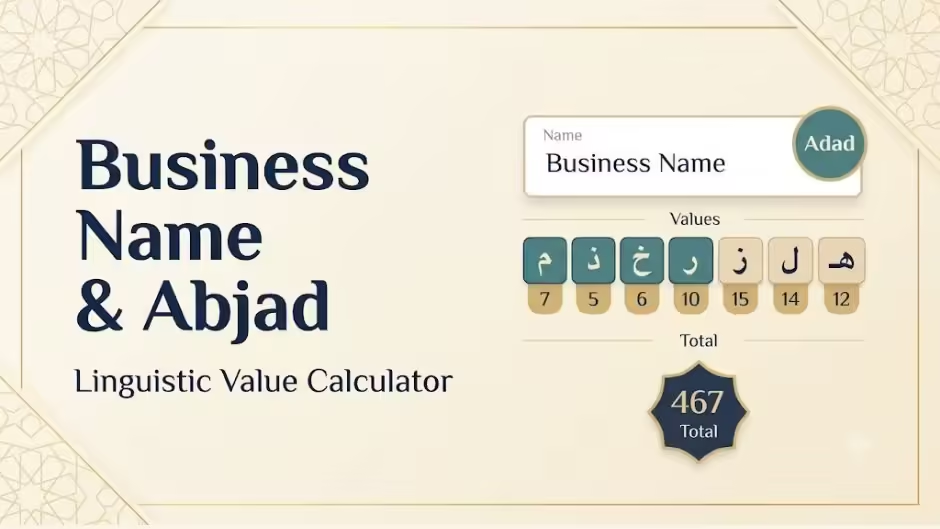
If you want to skip the manual arithmetic, the Business Name Abjad calculator on this site handles the full letter-by-letter breakdown automatically. You enter the name in Arabic, choose your preferred system, and the tool shows you the total and its components so you can see exactly how each letter contributes.
Worked Example: Two Names, One Decision
Suppose a founder named Khalid is choosing between two names for his consultancy: "Nur Consulting" and "Badr Consulting". He writes each in Arabic and runs both through standard Abjad Kabir calculation.
| Name (Arabic) | Abjad Kabir Total | Reduced Root | Traditional Association |
|---|---|---|---|
| نور (Nur, light) | 256 | 4 | Often associated with structure, reliability and sustained effort |
| بدر (Badr, full moon) | 206 | 8 | Traditionally linked to authority, cycles and material achievement |
Khalid's own name value reduces to 5, traditionally associated with adaptability and communication. A practitioner might argue that 4 (structure) balances Khalid's 5 (flexibility) well for a consulting practice, while 8 (authority) could feel heavier than the client-friendly tone he wants to project. This is interpretive, not definitive, but it gives Khalid a structured lens rather than a coin flip.
For deeper cross-referencing, some practitioners also look up how the name's root number aligns with relevant entries in the Asma-ul-Husna Abjad table, which maps the 99 names of God against their classical Abjad values. The idea is that a business name resonating with a particular divine attribute may reflect that quality in how the enterprise is perceived.
The Mistake Most People Make
The single most common error is calculating a romanised or translated version of the name instead of the agreed Arabic spelling. "Nur" in Arabic can be spelled with or without certain diacritical conventions depending on regional practice, and even one letter difference changes the total entirely. Always fix your Arabic spelling first, get agreement on it if you have partners, and then calculate. Using the Abjad calculator with a consistent Arabic input removes the arithmetic risk but not the spelling risk, so that first step remains your responsibility.
A secondary mistake is treating the result as a verdict rather than input. Abjad numerology is one perspective among many. A name also has to work phonetically, legally, in search engines and in print. If you are curious how this kind of multi-factor cultural evaluation applies to other decisions, the approach described in evaluating a wedding date with Islamic Abjad numerology follows a similar logic and reinforces how the same underlying system adapts to different life choices.
Things People Wonder
What is the difference between Abjad Kabir and Abjad Saghir for a business name?
Abjad Kabir (standard Abjad) uses the full classical letter values, where some letters carry values in the hundreds (for example, Qaf = 100, Ra = 200, Shin = 300, up to Ghain = 1000). Abjad Saghir reduces those values to single digits, so Qaf becomes 1, Ra becomes 2, and so on. For a business name, Kabir gives a larger raw total with more granularity, while Saghir gives a simpler root number that is easier to compare directly against founder name values or Asma-ul-Husna associations. Neither is universally correct; the choice depends on the practitioner's tradition or the framework you are working within.
Does the business name need to be entirely in Arabic for Abjad numerology to apply?
Traditionally yes, because the Abjad system is built around Arabic letter values and has no direct equivalent for Latin characters. If your business name is in English or another language, practitioners typically transliterate it into the closest Arabic phonetic equivalent and work from that. This introduces some subjectivity, because the same English name can be transliterated in more than one way, each producing a different total. Agreeing on a single Arabic spelling before you calculate is essential for consistent results.
Should I include the Arabic article Al (ال) in my business name calculation?
Only if your official trading name or brand name is always used with the article. Al Nour and Nour are numerologically distinct names. If you are registering as "Al Nour Consulting" and that is how clients and documents will always refer to you, include it. If the article is informal and the legal name omits it, calculate without it. Consistency between the legal name and the calculated name is what matters most.
Can I use Abjad numerology for an English-language business that will operate in non-Arabic markets?
Yes, some practitioners apply it regardless of market, treating Abjad as a universal symbolic framework similar to how Western numerology is applied globally. However, most classical guidance is oriented toward Arabic-speaking contexts, so interpretations are culturally rooted there. If your primary market and brand language are not Arabic, you might also consider running your name through a complementary tradition such as Chaldean or Western numerology for additional perspective. This site covers 200 or more free calculators across 12 traditions, so comparing methods is straightforward.
This article reflects the historical and cultural practice of Abjad name analysis as documented within classical Arabic and Islamic scholarly tradition. It is presented for educational and cultural appreciation only, and should not be taken as financial, legal or religious advice for business decisions.